ABOUT OUR BLOG:

In case you missed it, our luscious website (estuarymagazine.com) also features a blog—that strange information beast, a contraction between web and log, intended to add value to readers’ lives and to inspire action. In addition to offering back stories behind the magazine’s articles and features, the blog provides links to sources of activities and information, including past, present, and planned articles in the magazine related to the blog’s subject matter.

We identified in the inaugural blog four calls to action:

  • Subscribe to the magazine to learn more about the River—its wildlife, recreational opportunities, science and conservation issues, important people, lifestyle and culture, and fascinating history. Tell your friends and relatives about Estuary.
  • Go outside and enjoy the environment and recreational opportunities of the River and surrounding watershed; if this is not possible, experience the River vicariously through the features and high-resolution pictures in the magazine.
  • Become involved in meaningful conservation activities for the River and watershed. These may range from advocating for sound environmental policies in your state and town to engaging in environmental monitoring studies, in creating synergies among like-minded organizations to leverage scarce resources, in the removal of invasive species, in community development projects involving the River, in habitat management, and in the reduction of your carbon footprint, to name some. The blog will promote important conservation projects that will benefit from community participation.
  • Send us your ideas about the Connecticut River and its watershed in care of info@estuarymagazine.com. The same goes for your feedback about how to improve the magazine, including the topics that you would like to see in future issues and in its blog.

Several installments later our blog continues to be a learning experience for us, defined as the process by which we increase our capacity for effective action, that is, coaxing our readership’s involvement in the preceding activities. We are still learning in the blog how to facilitate navigation among topics with keywords, to narrate personal stories succinctly, to encourage participation, to provide evergreen (lasting) content, to use images, and to establish thought leadership by communicating influence and authority.
Looking ahead, we anticipate increasing the blog’s effectiveness by making it a greater team effort than it is today. Just as with the magazine itself, we will empanel a select team of competent contributors, with occasional guests, to brainstorm topics and to write, illustrate, and edit our blog’s content. What won’t change is our deep appreciation for your comments and feedback.

Gratefully,

Image

Ralph T. Wood
Editor, Estuary Blog

Editor's Log:
Island Solitude

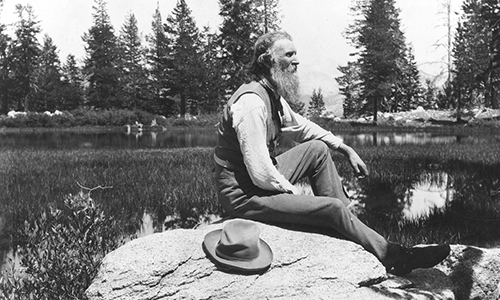
“Come to the woods, for here there is rest,” wrote John Muir, the pioneering environmental activist and writer. “There is no repose like that of the green deep woods.” Few knew the healing power of nature better than Muir (1838–1914), whose deep connection with the outdoors was forged through a convalescence. It was in March of 1867 that the Sottish-born Muir was working in a wagon wheel factory in Indianapolis when he suffered a serious eye injury. Confined to a darkened room for six weeks in order to regain his sight, the 28-year-old Muir, who had studied botany in college but never graduated, was forced to reflect on his life and his purpose. It was during this period of solitude, Muir says, that he determined “to be true to himself” and follow his dream of studying plants, immersing himself in nature and the outdoors. “This affliction has driven me to the sweet fields,” Muir later wrote. “God has to nearly kill us sometimes, to teach us lessons.”

Today, many of us find ourselves confined to our “darkened rooms,” or perhaps more precisely, as in Dante’s Inferno, trapped “in a dark wood, where the direct way [is] lost.” Dante goes on to tell us: “It is a hard thing to speak of, how wild, harsh and impenetrable that wood was, so that thinking of it recreates the fear.” His words speak to us over the centuries. Dante had Virgil to lead him out of the gloom. Who will be our guide?
When I really need to escape, I paddle my canoe over to an island in the lower Connecticut River—a rocky, wooded, wild place with a meandering creek and marshes on the back side. The day I visited, I beached my craft near the inlet on the northern end, following a trail into the woods up to the crest of a ridge, a couple of hundred feet above the river. Seated on a rock in a clearing, I looked down through the dark trees to the glittering water. It was late afternoon, when the sounds of the powerboats fade away and a deep solitude washes over the place. The stillness was a tonic.

John Muir, ca. 1902
Image Credit: Library of Congress

In that ethereal quiet it was hard to image that in the 19th century this island swarmed with 600 men, mainly Irish and Italian immigrants, who lived in camps from May to October to work the granite quarries. It was an extensive operation, with steam drills and derricks and a narrow gauge railroad to haul the massive blocks to waiting schooners. This island in the Connecticut River was known for its usually dense gneiss, prized in New York City and Philadelphia for street paving and curbing.

Quarrying ended abruptly in 1902, when the stone business was no longer profitable. The woods grew back, and the island became a haven for those who wanted to escape, for whatever reason. In the 1930s, a reputed gangster hid out on the island to evade capture. He built a lean-to against some rocks and camouflaged it with branches. Friends brought him food and supplies. The authorities never found him.

The island’s best-known hermit was a fellow by the name of Andrew Holloway. Jilted by his wife who favored his brother, Holloway vowed never to speak to another human being. He built a houseboat and paddled it to the island, where he lived as a recluse for 50 years. When friends came to visit, he communicated by writing on a slate.

A beautiful, wild, lonely place, this island.

–Erik Hesselberg, Managing Editor

\