
 This article appears in the Spring 2026 issue

How to Track a Hummingbird
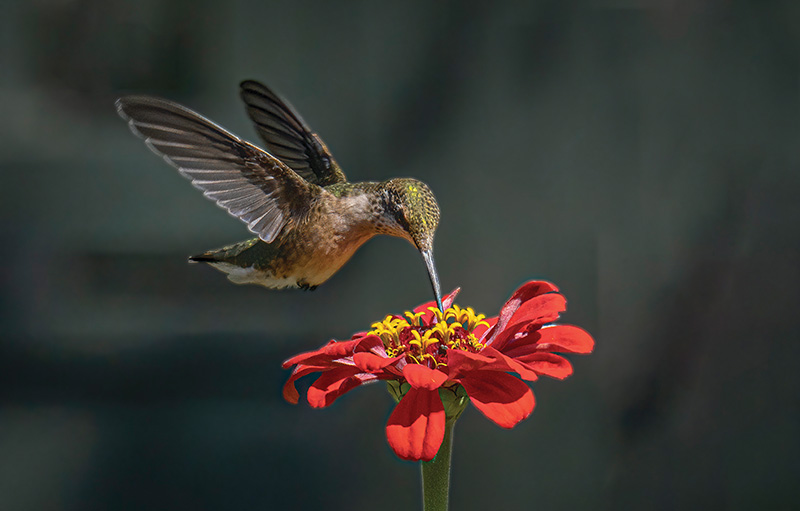
Ruby-throated hummingbird. Photo: Ingrid Feddersen.
Along the Alabama shoreline, two young, trailblazing scientists are emerging as leaders in ornithology. They are the first hummingbird banders in the United States to attach tiny BluMorpho solar-powered radio transmitters, each no heavier than a grain of rice and originally engineered for monarch butterflies, to the backs of ruby-throated hummingbirds to track their movements during the breeding season.
I visited them last April. Here is their story.
Early in the bird banding session, a ripple of excitement swept through the group as Emma Rhodes, Kyle Shepard, and volunteers captured their first hummingbird of the day: a female. She had likely just completed a perilous, nonstop 550-mile flight across the Gulf of Mexico.
That moment encapsulated why I visited this public bird banding event on Dauphin Island. It’s the first landfall for many birds arriving from the Yucatán during spring migration and a key site for studying hummingbirds and songbirds that may later breed as far north as the Connecticut River valley and beyond. I also wanted to meet Rhodes and Shepard, the two rising stars, in person.
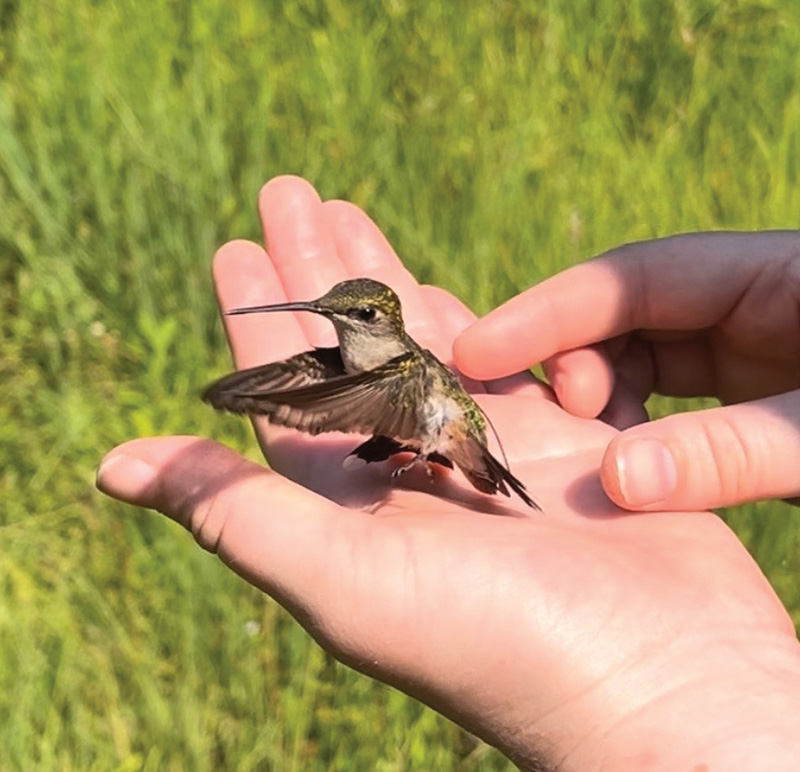
A ruby-throated hummingbird, with a Blumorpho tag attached, is released, Dauphin Island, AL, April 2025. Photo: Kyle Sheppard.
After carefully removing the tiny bird from the nearly invisible mist net, the team took it to the nearby banding table for a brief examination before releasing it back into the wild.
Rhodes, who completed her doctorate in summer 2025 and recently accepted a position as a postdoctoral fellow in the College of Health Sciences at the University of Memphis, is one of only several hundred federally- and state-licensed master hummingbird banders in the country.
Rhodes told the gathering that most songbirds and hummingbirds transit the gulf in 17 to 24 hours. With a tailwind, they can possibly do it in 16 hours. “From our anecdotal observations, hummers fly just over the surface of the water, at least when approaching the Alabama coast,” she said, adding, “We don’t know about the middle part of the flight, but they seem to fly below the turbulent winds, while others tend to fly above the turbulence.”
As onlookers encircled the bird banders, skilled hands quickly measured and recorded a range of data. The site location; method of capture (net or trap); the exact time of capture; weather conditions; whether the hummingbird was already wearing a band; sex and approximate age of the bird; wing, tail, and bill length; weight; fat, muscle, and feather condition; and indicators of breeding status, among other details, were all carefully noted.
After the team finished processing the hummingbird and attaching a tiny metal identification band around its leg engraved with a letter and a few numbers, one young spectator was treated to a rare thrill: she held the little bird for a few wondrous moments and then set it free.
Why band birds? Rhodes explained that without a band, we know almost nothing about an individual bird. Once a bird is marked, however, researchers can track their migration patterns, lifespan, and breeding success. It is akin to giving it a social security number.
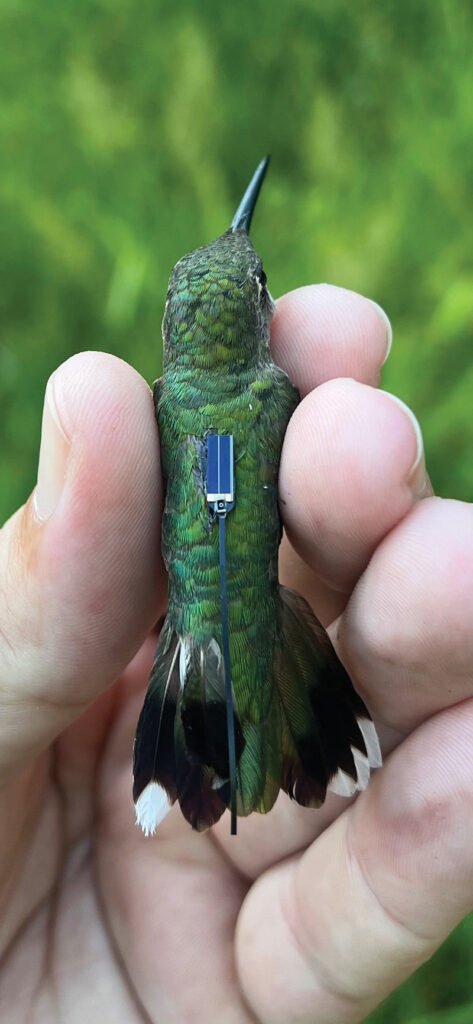
Blumorpho tag, originally engineered for monarch butterflies and available
since 2023, attached to a ruby-throated hummingbird. Photo: Kyle Shephard
“Any data we collect here will then get reported to the US Geological Survey’s Bird Banding Lab. They are the clearinghouse for the entire US and its territories. There is also a sister office in Canada and growing communications with Mexico. So, there’s a lot of really good communication between us, Canada, and Mexico, sharing information between databases,” Shepard added.
Rhodes and Shepard have spent the past three springs banding birds here, partnering with the volunteer-run Dauphin Island Bird Sanctuaries, a 501(c)(3) focused on protecting the island’s vital habitats. In the fall, they band at Fort Morgan, Alabama, just across the mouth of Mobile Bay from Dauphin Island, an ideal vantage point for catching migrants headed to their winter grounds.
After years of learning from Bob and Martha Sargent, founders of the Hummer/Bird Study Group in Fort Morgan, Alabama, Rhodes, 30, and Shepard, 33, cofounded the Banding Coalition of the Americas in 2020. This nonprofit research organization conducts bird banding and monitoring to study migration routes, population dynamics, and habitat use throughout the Americas, collaborating with scientists, students, and community volunteers.
What’s striking about these young scientists is their readiness to tackle tasks others avoid, embracing new technology, managing the paperwork, and doing whatever it takes to get the job done. For example, when BluMorpho transmitters or “tags” were first released in 2023, Rhodes said everyone in the hummingbird banding community wanted to use them, but no one wanted to be the guinea pig and do the paperwork and hard work associated with setting up the system of tracking using this new technology. “Kyle and I were crazy enough to volunteer.”
Powered by sunlight, the tiny BluMorpho tag emits an ultra-high frequency signal every second, which is detected by Motus tracking stations, a radio-receiver station that is part of an international network used to track the movements of birds, bats, and insects. When a station picks up the signal, it records the tag ID number and timestamp, allowing researchers to estimate the bird’s position, its proximity to the station, and its movement.
Rhodes and Shepard received permission from the Bird Banding Lab to conduct tests in two locations: in spring 2024 on a friend’s property in Whitley County, Kentucky, and in summer 2025 on a remote, 1,200-acre ranch in southeastern Idaho.
Kentucky served as the proving ground for BluMorphos, Shepard said. After learning to trim a small patch of feathers on each hummingbird’s back and attach the tag using a blend of eyelash glue and super glue, the team wanted to know whether the birds could still fly, forage, and go about their normal routines. “Thankfully, the answer was ‘Yes,’” said Shepard. The Idaho site expanded the project to a larger scale, allowing the researchers to fit BluMorphos on three hummingbird species: black-chinned, broad-tailed, and calliope hummingbirds.
In another example of Rhodes’s and Shepard’s proactive approach, Alabama was the last state along the northern Gulf Coast to install a Motus station (Connecticut, by contrast, now has 15 Motus stations.). “Kyle and I were tired of waiting,” Rhodes said. Once they secured funding from organizations like The Cornell Lab of Ornithology, the two agreed to install the station themselves and cover ongoing maintenance and data costs. The station went up in September 2023. “Now, any bird that flies up Mobile Bay between Dauphin Island and Fort Morgan with a radio transmitter on will be detected,” Shepard said.
What lies ahead for these two high achievers? In January, Rhodes and Shepard will travel to Costa Rica to train renowned raptor bander Ernesto Carmen in using BluMorpho transmitters to band and tag hummingbirds. Shepard also plans to support colleagues adopting this new technology in Alaska, Wyoming, and Colorado.
Finally, I asked Rhodes and Shepard what encouraging developments they’re seeing in the world of ornithology. “For me, the most positive trend is the vast number of people who have joined the birding community. That’s been especially clear since COVID,” Shepard said.
Rhodes agreed. “We’re now seeing Instagram influencer birders drawing younger people into birding and conservation, and that’s incredibly promising.” She is also optimistic about migratory birds in general. “They’re sturdy. You get juveniles in the fall that don’t know what they’re doing. But with many adults, if they have a home, a habitat to breed, rest, and winter in, they know what they’re doing. They know their routes. They have it down pat.” Perhaps in the not-too-distant future, as this technology develops, we’ll detect hummingbirds carrying BluMorpho transmitters in New England and learn more about their long journeys.
Bill Hobbs is a contributing nature writer for Estuary magazine and The Times newspapers of New London, Connecticut. His email is whobbs246@gmail.com.