
 This article appears in the Spring 2026 issue
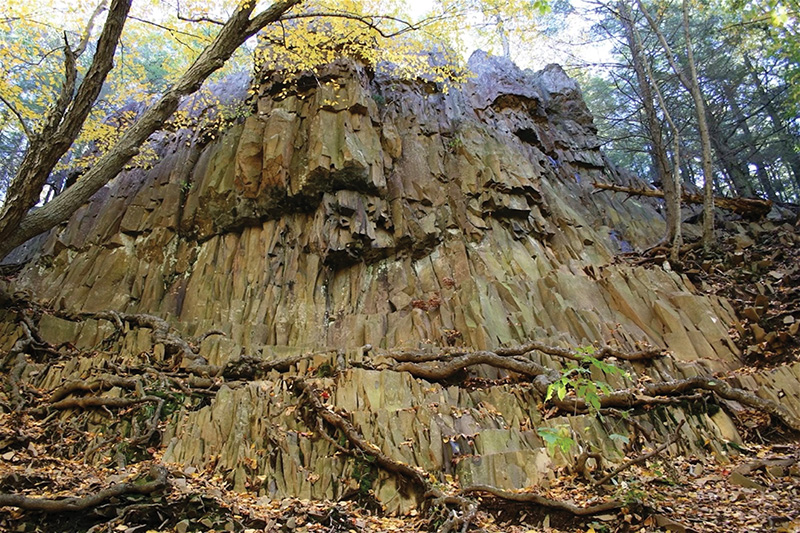
An exposure of basalt, a volcanic rock located near the top of Talcott Mountain. FRAP has found fragments of basalt at archaeological sites throughout the Farmington Valley, used by the inhabitants for sharp-edged, often heavy-duty tools. Photo: Ken Feder.
The First People
of the
Farmington Valley
Soon after the first English settlers of the Connecticut River valley arrived in Windsor in 1635 and 1636, they conducted a series of walkabouts, searching for additional lands they viewed as “unimproved” or seemingly unused and, therefore in their view, free for the taking. Sometime during their explorations and before 1640, the English came to the edge of a nearly vertical cliff, technically a volcanic escarpment, leading down to a vast and verdant flatland. It was a new world that seemed created by Providence expressly for English farms and settlements.
There was a problem, however. Spread across the valley they would have seen smoke curling up from the hearth fires of the numerous settlements of a people who already called this place their homeland. These people had, at various times following their arrival in the deep past, fished in what’s now known as the Farmington River and used it as a highway for transportation and trade; hunted animals like deer, raccoon, and rabbit living in the thick woodlands; built and lived in dome-shaped dwellings clad with bark, reeds, or woven mats; cleared forest and planted corn in the rich alluvial soil that marked the margins of the river; and used tools and vessels from stone and clay.
Historically, these indigenous people called themselves the Tunxis, though subgroups used various names. Their archaeological traces, uncovered during a dig conducted from 1980 to 2019, show that their ancestors, both direct and indirect, called the valley home for more than 12,500 years. These archaeological traces have enabled us, through the Farmington River Archaeological Project (FRAP), to tell the story of the Farmington Valley’s First People.
The Paleoindian Period
Archaeologists are time travelers. When we journey back 12,500 years to the Farmington Valley, we encounter a place characterized by very different environmental conditions from those we see today. There were no dense stands of oak, maple, or hickory. There were no deer, beavers, raccoons, or even moose. The pollen “profile”—the percentages of pollen produced by different plant species falling on Connecticut over the past 12,500 years—has been preserved in layered sediments at the bottom of Rogers Lake in Old Lyme. The species and their percentages reflected in that pollen profile are nothing like those of the present.
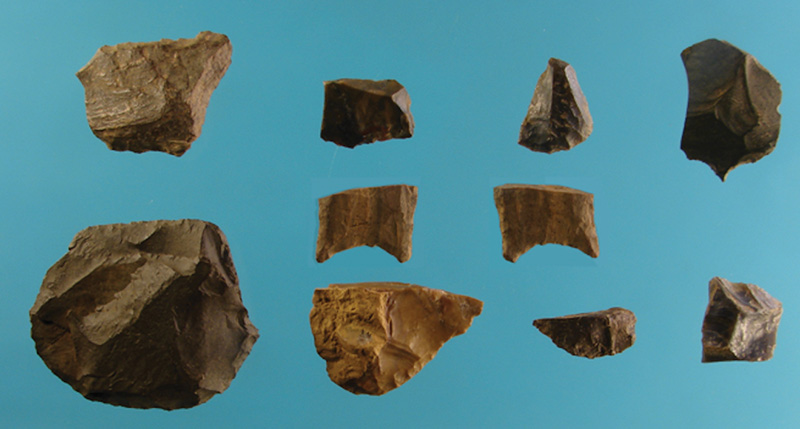
Stone knives, scraping tools, a perforator, and (center) bases of two fluted spear points recovered from the 12,500-year-old Brian Jones Site in Avon, CT. Courtesy of Sarah Sportman.
The best analog for Connecticut at that period is the pollen “rain” falling today in the treeless expanse of the Arctic tundra of northern Canada. The dominant plant species there are sedges, and the most common animals are caribou. When we exit our archaeological time machine, this is the world with which we are confronted, and these are the conditions faced by the Farmington Valley’s original residents.
One group of the valley’s first residents inhabited the Brian Jones Site in Avon, so named in honor of Brian Jones, the state archaeologist who initiated this project and died unexpectedly in 2019. There, in an encampment dating to about 12,500 years ago, residents made stone tools, hunted animals, collected plants, and cooked their food in several fireplaces. Among their weapons were so-called “fluted” spear points, a style found all over North America dating to this period and characterized by concave channels—the flutes—on both faces, probably to facilitate hafting (attaching the point) onto a wooden shaft.
These Paleoindians were likely not permanent residents of the valley. They traveled great distances as part of a seasonal round that brought them to this spot adjacent to the Farmington River in their search for food. Material evidence of a nomadic life is found in the raw materials from which they crafted their tools. The raw stone they used was not local to the valley. It was brought in from west of the Hudson River in what today is New York State.
Only one other excavated habitation site in Connecticut dates to this period: Templeton in the Shepaug River Valley in Washington, Connecticut. It is fair to surmise that Connecticut in general, and the Farmington Valley in particular, was sparsely populated in this early period following the end of the Pleistocene or Ice Age.
The Archaic Period
Beginning 9,000 years ago, the archaeological record of Connecticut shows a larger and growing population in what is called the “Archaic Period” (9,000 to 3,000 years ago). The Native occupation of Alsop Meadow, also in Avon, dates to this period, approximately 5,000 years ago.
The stone tool makers at the site were accomplished geologists. They climbed what is today called Talcott Mountain (or King Philip or Avon Mountain) and collected fragments of the volcanic rock geologists call basalt (colloquially called traprock). There are places on the mountain where this hardened lava is exposed and erodes into prismatic fragments, perfect as core material that can be carried down the mountain and made into stone tools.

Left: A basalt spear point, about 3 inches long, found at the 5,000-year-old Alsop Meadow Site in Avon, CT. Middle and Right: Hornfels artifacts (a spear point and a drill about 2 inches long) from the 5,000-year-old Alsop Meadow Site in Avon, CT. Hornfels, preferred for thin, sharp-edged tools, is a form of metamorphosed sandstone produced in places where the molten lava flowed over and baked the underlying sandstone. Photos: Ken Feder.
The basalt cliffs face west and demarcate the eastern edge of the Farmington River valley, consisting of three temporally distinct, ancient lava flows. However, not all basalt is created equal, and the Native People of the Farmington Valley knew the locations where those exposures presented the finely grained material best suited for making durable, sharp-edged tools.
Making stone tools requires enormous skill, diligence, and patience. It really is a combination of science and art, to know exactly how different kinds of rock break and to be able to carefully control that breakage to produce symmetrical tools of the desired size, shape, and thickness. Those tools are useful, efficient, and, at the same time, often quite beautiful.
These same people also recognized that in some places the black and grey basalt rested directly on top of a softer reddish rock, today called sandstone (also called arkose or brownstone). This red rock didn’t take an edge very well but served a valuable purpose for ringing hearths to bank heat. Sandstone is so common in Connecticut, it is officially designated as our state rock.
The indigenous residents of the valley also knew that in a few places on the mountain, between the red rock and the overlying basalt, there was another darkly hued stone type that was almost glass-like, providing a raw material very useful for making thin, sharp, and durable tools. Today geologists call this rock hornfels and identify it as a metamorphosed sandstone, transformed when the incandescent lava that became the Talcott Mountain basalts flowed over the older sandstone some 200 million years ago. The residents of Alsop Meadow used hornfels to produce remarkably sharp and exquisitely crafted tools including spear points, knives, and even drills.
Another kind of rock, one not amenable to the production of cutting, piercing, or scraping tools, was also used. Technically, this rock type is called steatite but is commonly referred to as soapstone for its smooth, slippery feel, a result of a high concentration of talc. Steatite was soft enough to be carved into vessels for storage and cooking. It’s also waterproof, fireproof, and not susceptible to thermal shock; it doesn’t shatter even when cold and then quickly exposed to high heat over a fire, for example. These characteristics rendered steatite a preferred raw material for cooking vessels until about 3,000 years ago when it was replaced by ceramics made from clay.
Steatite’s natural distribution is patchy, rendering it a valuable trade commodity throughout the Farmington Valley, the State of Connecticut, much of New England, and even south into Long Island. We have excavated one of those significant sources of steatite at the Walter Landgraf Soapstone Quarry in Barkhamsted, located at the western margin of the Farmington Valley.
While steatite was an important material, the fact that it was available only in limited locations was a complicating factor in its use in those territories that didn’t possess the mineral. In other words, demand was high, but at least geographically, supply was low and limited.
A Time of Change: The Woodland Period
The challenges posed by steatite’s limited availability set the stage for its ultimate replacement. There’s a concept in economics called “disruptive innovation.” It refers to an invention, raw material, or industrial process that is so revolutionary, so disruptive to the status quo that it has a ripple effect, resulting not just in the evolution of a particular technology, but in significant changes in the society. Making cooking and storage vessels out of clay was just such a disruptive innovation. Prior to the introduction of ceramics from the south and west, an enormous amount of social and economic capital was expended in establishing and maintaining trade networks for the dissemination of steatite across southern New England. Those who had direct geographic access to sources were greatly advantaged.
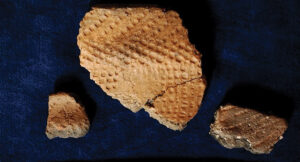
Ceramic sherds recovered from a 2,000-year-old site in the Farmington Valley. Note the decorative stippling on the large sherd (center), made by impressing a toothed tool into the soft clay before firing. Photo: Ken Feder.
Once ceramic technology entered Connecticut, clay replaced soapstone as the dominant raw material for cooking vessels, and local economic systems changed fundamentally. Clay is available practically everywhere. There was no longer a need for the “have-nots” to produce valuable products for trade to obtain steatite from the “haves.”
The oldest ceramic objects in the Farmington Valley are about 3,000 years old, dating to what is labeled the Woodland Period. Not coincidentally, this is contemporaneous with the abandonment of the aforementioned Walter Landgraf Soapstone Quarry where no fewer than five incomplete bowl forms are still attached to the quarry stone. A significant amount of work had been expended in pre-shaping these vessels as they were being quarried, and yet they were abandoned in the middle of the work. How can we explain that? One can imagine quarriers working diligently to produce soapstone bowls for trade when the news arrives that existing customers no longer need them since they could collect their own raw material in the form of clay.
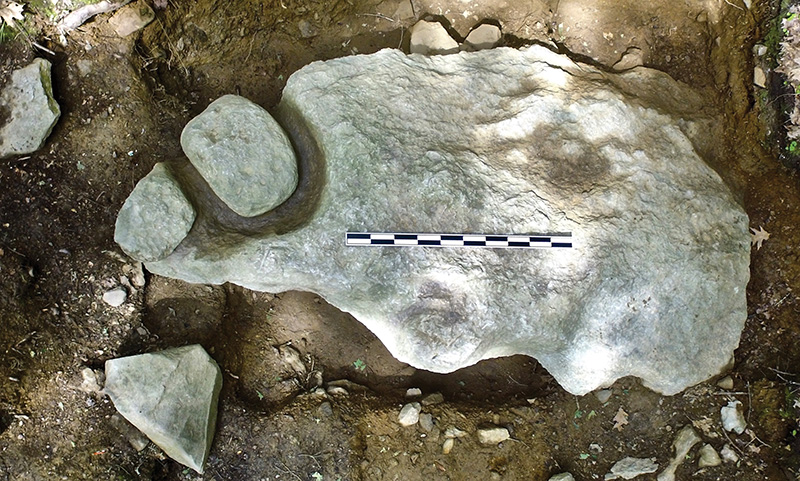
The Walter Landgraf Soapstone Quarry, Barkhamsted, CT, contains unharvested bowl forms, shown at left. Once extracted from the quarry, these blanks would have been hollowed out with tools made from a harder rock like quartzite. The scale is one meter in length. Photo: Ken Feder.
It is toward the end of this period that agriculture in the form of, at least, maize (corn) and squash became an important, though by no means the sole, source of the indigenous diet.
Contact and Change
My brief telling of the native history of the Farmington Valley has now circled back around to where I began—with the arrival of the English. English settlers saw the Farmington Valley before 1640, and they wanted it. Ostensibly in a treaty that has been lost to history, the English purchased the entire valley, amounting to 300 square miles of territory, from the sachem (leader) Sequassen. Curiously, Sequassen didn’t live in the Farmington Valley, but instead was a leader of the Saukiog people living in the Connecticut River valley. The legality of that sale, from either an English or Native perspective, is highly suspect given the two parties’ very different conceptions of land ownership. Certainly the Tunxis living in the Farmington Valley were unpleasantly surprised when English folks began moving into their homeland, building houses, clearing woodlands, planting crops, and erecting fences to make concrete their contention that these lands were now “private property,” a concept and construct they did not have.
We know how the Tunxis felt about this because they expressed their objections in a series of letters of complaint they submitted, with help from English settlers sympathetic to their plight, to the General Court of the Connecticut Colony in Hartford. For example, in a document dated to 1650, the General Court stipulated that there should be a formal agreement directly between English settlers and the Tunxis “as tend to settle peace in a way of truth and righteousness betwixt ye English and them.…” Unfortunately for the Tunxis, though that preface expresses the admirable goal of an equitable solution to land issues, it also maintained that it was a given that, “The Indians had given up all of the lands in the valley in the 1640 treaty, with the exception of an area: encompassed with a creek and trees.…”
This may have been what Sequassen had in mind, but he was lacking any input from or consultation with the Tunxis. The area “encompassed with a creek and trees” and reserved for the Tunxis in the 1650 document is a place today called Indian Neck, amounting to about 90 or 100 acres. Indian Neck is located south of Rte. 4 and the sewage treatment plant in Farmington. This, apparently, was the location of an existing Tunxis village upon the arrival of the English. Archaeological artifacts recovered there through FRAP support this deduction. We found a mixture of traditional stone tools and pieces of English ceramics likely obtained by the Tunxis through trade with the English settlers of the town of Farmington.
In a phrasing that, if anything, reflects the chutzpah of the English, the 1650 document suggests that, while the Tunxis had lost nearly all of their land, they nevertheless had greatly benefitted from the presence of the English:
The peace and the plenty that they have had and enjoyed by ye presence of ye English in regard of protection of them and trade with them makes more of ye advantage and comfort of ye Indians though they hire some land than ever they enjoyed before ye coming of ye English when all ye land was in theyer own disposal... Therefore, ye Indians have reason to live loveingly among ye English by whom theyer lives ever are blessed and theyer estates and comforts advantaged.
A modern map superimposed over a hand-drawn layout produced in 1673 shows that the English believed that the 1640 treaty included large swaths of the modern towns of Farmington, Avon, Burlington, Bristol, Plainville, Wolcott, Southington, New Britain, and small bits of West Hartford and New Hartford.
The Tunxis, with unvarnished language, continued to assert their rights and petitioned the General Court to address their grievances, asking in 1738 that:
The encroachments of the Englishmen may be removed and ye right and property of ye poor Memorialist [Tunxis] Indians may not be sacrificed to satisfy the avaricious humour of designing Englishmen.
That, of course, did not happen, and the Tunxis ultimately became dispossessed of all of their lands in the Farmington Valley. Most of them left Connecticut and joined the Brothertown Indian Nation, a group of Christian Indians established by the Mohegan Reverend Samson Occom. The Brothertown Indian Nation includes Native People who can be traced to the Mohegan, Western Pequot, Eastern Pequot, Niantic, Montaukett, and Tunxis tribes. Far from their original homelands in Connecticut, these people today reside in Wisconsin. They have no reservation there, but they do have a community center.
The archaeology of the Farmington Valley tells the story of a vibrant Native people who entered the region more than 12,500 years ago, adapted to harsh late- and post-glacial conditions and continued to adjust as those conditions changed over time. They developed and refined technologies that allowed them to thrive in the valley. The only thing they could not adapt to was the entry of a people not content to share the land but desirous of possessing all of it. “Small in number and being now of small power and not willing to otherwayes contend,” (their words in a letter of complaint dated to 1672), the Tunxis had little choice but to leave Connecticut entirely. The archaeological and historical records that inform the Farmington River Archaeological Project allow us to tell their story.
Ken Feder, PhD, is professor emeritus (Anthropology) at Central Connecticut State University with a focus on the archaeology of the Native Peoples of New England and the analysis of public perceptions about the human past. He is the author of Frauds, Myths, and Mysteries: Science and Pseudoscience in Archaeology (Oxford University Press, 2026, 11th edition); The Past in Perspective: An Introduction to Human Prehistory (Oxford University Press, 2024, 9th edition); Native American Archaeology in the Parks (Rowman & Littlefield, 2023), and Native America: The Story of the First Peoples (Princeton University Press, 2025).