
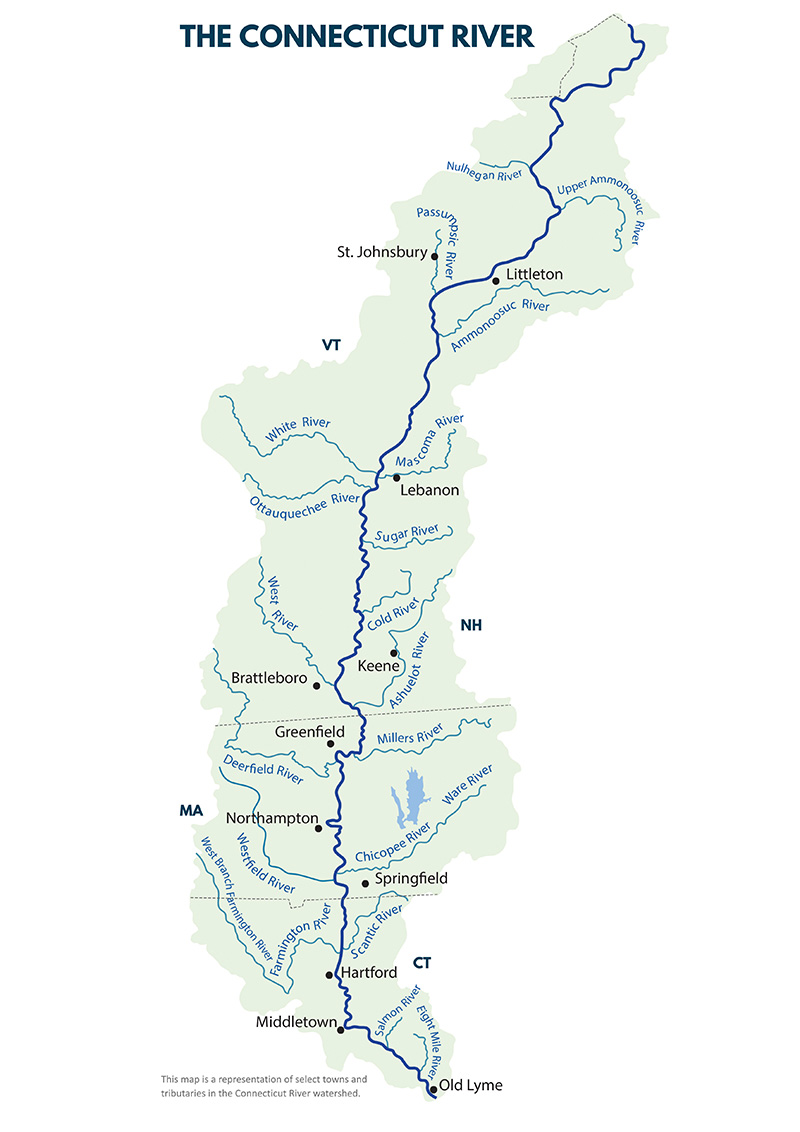

 The Connecticut River Conservancy (CRC), the primary nongovernment steward of the river since 1952, has announced a new strategy, an ambitious five-year plan memorialized in a document that is, itself, a work of art. To cite CRC’s executive director, Rebecca Todd, “Strategic planning allows us to focus our resources where they will have the greatest impact. This new plan reflects months of visioning and stakeholder input, and we’re excited to share it with our partners, supporters, and the entire watershed community.”
In light of the plan’s huge potential for the entire watershed, we cite below the plan’s four primary goals, followed by some thoughts from Estuary:
“Promote the adoption of a shared agenda for protecting and restoring the watershed.”
Seeking opportunities for effective collaboration is almost always a good thing, a mission that we and our parent, The Watershed Fund, share. What can an organization do with others that is bigger than what it can accomplish on its own? It’s the secret to having the whole be greater than the sum of its parts. This is a noble effort to expand beyond previous work and funding boundaries to improve watershed ecology. Significant benefits can be realized by pooling talent, expertise, geography, and other resources—not as competitors but as partners.
“Improve ecological health of riparian and aquatic habitats.”
This is CRC’s core area, historically, of talent and expertise. CRC works with state and federal entities in addition to a multitude of nonprofits in the watershed. With sufficient funds and management oversight, they can hire and train as needed and assign personnel where and when needed. It has long been recognized that CRC was spread rather thinly throughout the watershed relative to what was needed and eminently justified. CRC can address this by expanding its current well-honed capabilities—and in fact has already begun to do so with the addition of full-time staff members dedicated to Aquatic Invasive Species and Aquatic Ecology.
“Deliver CRC’s full mix of strategies across the entire watershed.”
Based in Greenfeld, Massachusetts, CRC is more or less centrally located in the watershed where much of its work has necessarily been located within striking distance of its main office. But the need for CRC’s work extends throughout the watershed. With river stewards stationed in each state, CRC currently has good outreach, though it is necessarily shallow given current budget constraints versus the magnitude of the tasks that lie ahead. For example, there are approximately 1,500 dams that are potential candidates for removal, plus at least as many culverts inadequate for handling the current worsening climate. This argues for a vastly greater scale of action. Their goal to assess, prioritize, and address problems throughout the watershed’s seven million acres is welcome and will constitute a major step forward.
“Build a strong foundation for growth.”
The expanded presence represented in the new strategy will require, incrementally, more money and talent. Just as the watershed needs greater sustainability and resilience, the organization needs much the same. The funds to hire additional talent and tear down dams and plant trees is often easier to obtain than indirect expenses so essential for good management and implementation of well-conceived strategies. CRC has produced the vision and plan; now it needs the financial and organizational capacity.

Key initiatives in the plan include pursuing strategic litigation to strengthen protections and celebrating CRC’s 75-year legacy of river stewardship. The plan also includes launching a periodic State of the Watershed report, with the first one to appear in 2027, focusing on aquatic and riparian areas. With over seven decades of experience in advocacy and restoration within the Connecticut River watershed—20 years longer than the Clean Water Act—this organization is no stranger to addressing environmental challenges from multiple angles.
CRC characterizes itself this way: “With boats in the river, hard hats in the field, and testimony in the statehouses, we are prepared to deliver results that benefit local communities and the watershed at large.”
As Diana Chaplin, Director of Communications at CRC, explains, “This is a challenging time to embark upon ambitious conservation and restoration plans, yet it is also imperative to safeguard a healthy watershed for all. Collaboration at the local, state, and federal level continues to be vital for future progress.” We, at Estuary and The Watershed Fund, will look for ways we can support CRC in implementing this new strategic plan. We encourage others to do likewise.



Dick Shriver
Publisher & Editor