
 This article appears in the Spring 2026 issue

Miscanthus Misgivings
Why Looks are Not Everything When Choosing Garden Plants
A number of years ago I planted an ornamental grass in my garden, having seen it in other yards and fallen in love with the exquisite plumes of seed-heads that it produced in the fall. It was somewhere around 2012; I remember because this plant came through the winds and rain of superstorm Sandy with little damage. It’s tough. But at some point, it became too big. By the time I decided to move it, it was necessary to employ an axe.
That was my introduction to Miscanthus, also called silver grass, maiden grass, or most descriptively, plume grass. And it is beautiful, which is why there are more than 50 forms sold in the US nursery trade.
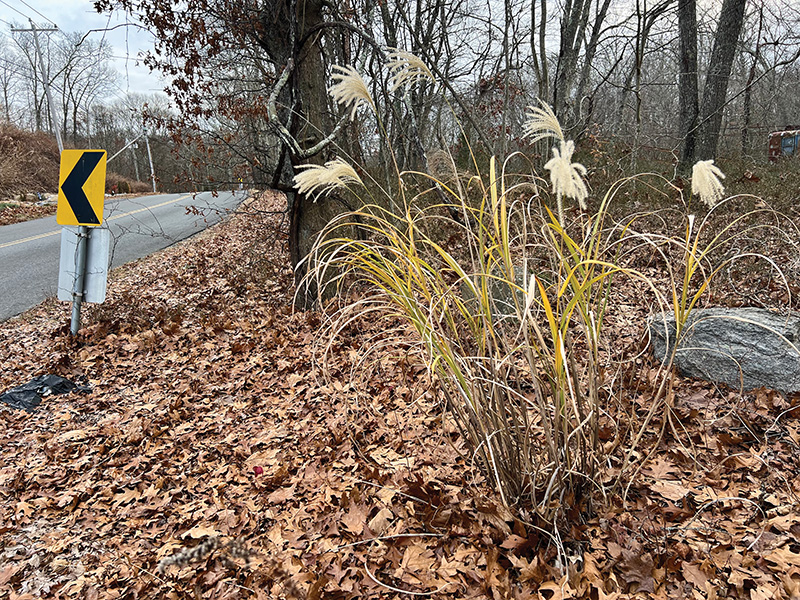
Once you know what to look for, Miscanthus can be found along roadsides and other disturbed sites, such as this plant in
Old Saybrook, CT. Further south—along sections of the New Jersey turnpike—it is unfortunately becoming well established.
But this plant can be aggressive and spread rapidly, creating dense stands. It expands by means of thick, horizontal underground stems, called rhizomes, that sprout new growth—not unlike another familiar invasive in the estuary region, Phragmites. And like the reviled non-native, invasive plant Japanese knotweed (Reynoutria japonica), Miscanthus roots can cause structural damage to house foundations, walls, and roads. In regions where wildfires are a threat, this plant is a major hazard.
In New England there are two Miscanthus species (M. sinensis and M. sacchariflorus) that have become naturalized, meaning that they can survive and reproduce in the wild—the same trajectory that non-native, invasive burning bush (Euonymous alatus) and privet (Ligustrum vulgare) have succeeded at. Miscanthus is considered invasive in at least 18 states; it has naturalized in over 25. It is found predominantly in the eastern states, west to Illinois and south to Florida.
Unfortunately, our changing climate is expected to enhance the success of this plant. While Miscanthus has been shown to be vulnerable to extreme cold, it will thrive in increasingly warmer environs with a longer growing season. And the ability of increasing storms and floods to expose bare ground will give them ample opportunity to become established.
While observing local landscaping is an easy way to think about what you might like to plant in your yard, it doesn’t tell us about how those plants “fit” into our local, native landscape. Too often they come from distant places—in the case of Miscanthus, Eurasia, Africa, and the Pacific Islands. In those environs, they thrive and benefit a local ecosystem by providing resources for local insects and other wildlife. But here, halfway across the globe, they have an unfair advantage—no or few predators.
That may sound ideal (no bugs to worry about), but when a disproportionate amount of our plantings don’t offer food or shelter for our native fauna, our suburban communities become ecological deserts.
But wait! There is some good news. In 2025, thanks to organizations such as the Connecticut Invasive Plant Working Group (cipwg.uconn.edu), public act PA 25-126 was passed, which will prohibit Miscanthus sinensis “from sale with a 3-year phase out period (effective October 1st, 2028).” It’s a start.
What You Can Do
There’s nothing prohibiting us from being preemptive of the legislation. The best action is to know what you’re buying at the nursery, or grocery, or big box store. While it is thought that four varieties of Miscanthus are considered sterile (so they cannot spread), there are questions—even within the nursery trade—about that. The Callery pear (Pyrus calleryana) was thought to be sterile when introduced in the early 1900s, only to find that it is highly invasive today in many suburban landscapes.
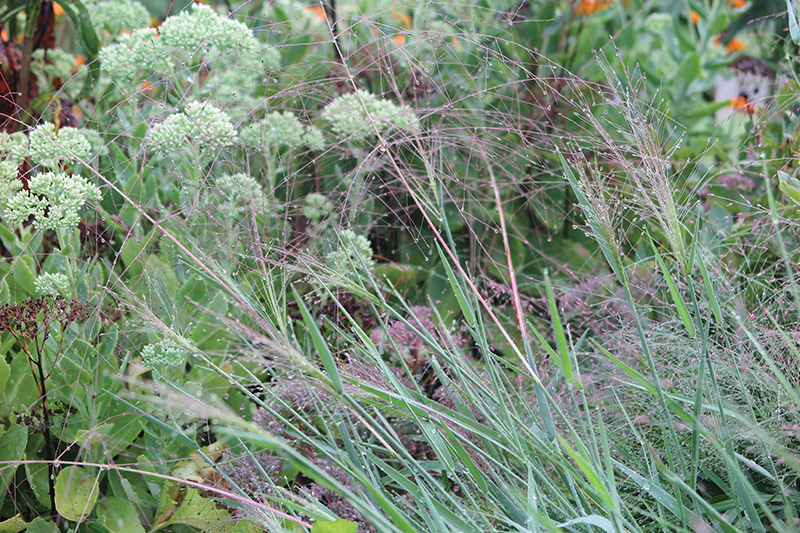
Purple love grass (Eragrostis spectablis) has a beautiful seed head and is a good native alternative.
Instead, consider these native alternatives:
Purple lovegrass (Eragrostis spectablis)
Little bluestem (Schizachyrium scoparium)
Broomsedge bluestem (Andropogon virginicus)
Pink muhlygrass or pink hair grass (Muhlenbergia capillaris)
Switchgrass (Panicum virgatum)
Indiangrass (Sorghastrum nutans)
Cultivated natives* include:
Compact/dwarf: Panicum virgatum “Shenandoah,” Panicum virgatum “Cape Breeze”
Vertical/tall: Panicum virgatum “Northwind,” “Thundercloud,” “Cloud Nine”
Giant form: Panicum virgatum “Cloud Nine,” Andropogon gerardii “Karl’s Cousin”
Color/seasonal interest: Panicum virgatum “Ruby Ribbons”
If you already have Miscanthus, especially the two that have become naturalized in New England (M. sinensis and M. sacchariflorus) consider taking it out, and be prepared to remove the entire rhizomal root system to prevent regrowth. Although chemical control is possible, if you have a well-established clump, it may require persistence (and more herbicide than you want to use). An alternative is to remove the seed heads every season in the fall. While they can make a tempting arrangement indoors, be certain to dispose of the seed heads in the trash, not your compost pile, as the seeds can remain viable for multiple years.
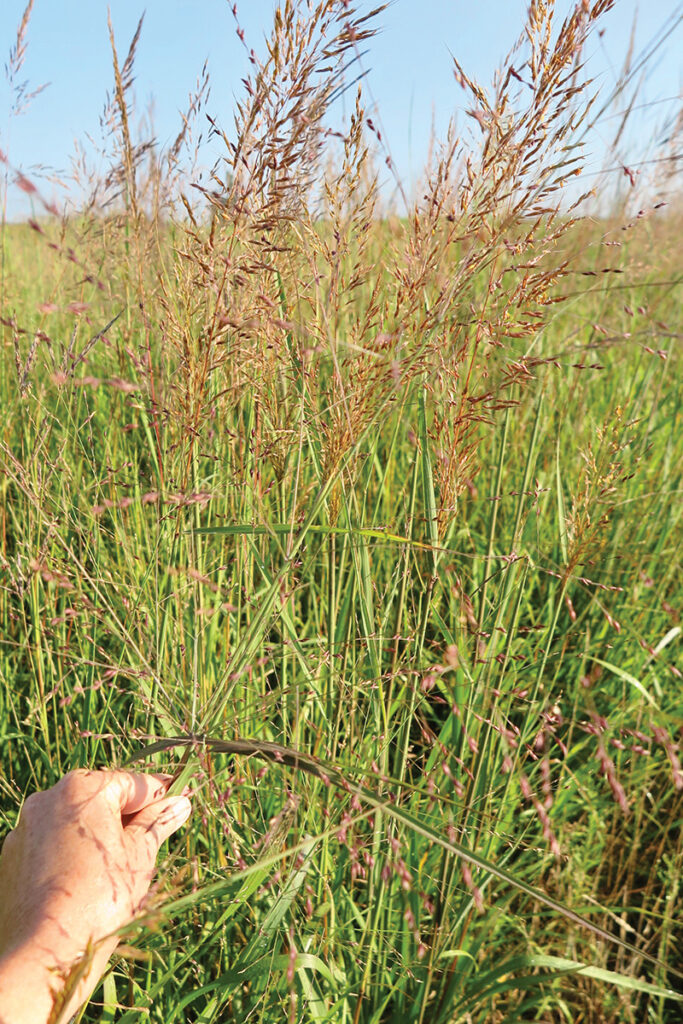
Indiangrass (Sorghastrum nutans), a good native alternative, growing wild.
Early detection and rapid response is the mantra of land management for invasive control; it is much easier to control troublemakers while the populations are small.
If you find this plant growing in the wild, consider documenting it—take pictures of naturalized plants and upload them to online platforms such as iNaturalist or iMapInvasives. This will help scientists and land managers keep track of this plant’s invasion potential.
And, as always, don’t be shy suggesting alternatives to others. Urge landscapers and local nurseries to stop using and selling Miscanthus and instead employ hard working native alternatives. Given the chance, the natives can provide attractive and ecologically beneficial substitutes.
Judy Preston is a local ecologist active in the Connecticut River estuary.