
 This article appears in the Spring 2026 issue
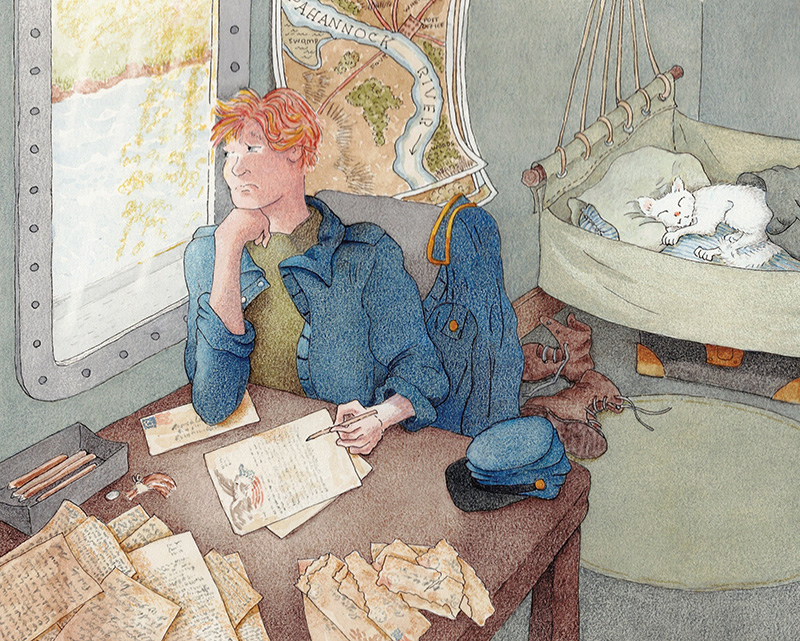
Chapter 21: Mail Call
Dear Son,
Your father and I were glad to receive word that you and Raymond have been given charge of a riverboat ferry. This puts us a bit more at ease, as this is work you both know, and we hope will keep you far from any battlefield.
You asked for news from home.
A pall has settled over Saybrook with the return of the body of the Tully’s son, John, who died of diphtheria while serving in the war. John’s parents were prepared for the eventuality that his body would arrive at the Saybrook Station House in a plain government burial box, so they waited at the station with a fine black walnut coffin ready to receive his body. The coffin came at the cost of fifteen dollars. So much for a family to bear at a moment of such tragedy.
Wasn’t it John who taught you how to dig for clams?
Several feet of fallen snow has created a welcome hush over Saybrook, until that silence is shattered daily with the sound of the heavy guns practicing maneuvers at the navy school, and we are reminded, once again, that we are a country at war.
Your father and I pray for you every day, my son.
It wasn’t even first light when I was awakened abruptly by the sound of horse’s hooves clip-clopping onto the old wood dock alongside the ferry. I crawled out of my hammock, stepped into my boots—no time to lace them up—grabbed my jacket, and scrambled down the ladder to the main deck, arriving just as a lieutenant jumped down from his horse. He untied a big canvas mailbag from the back of his saddle, held the sack out toward me, reached over the mooring line. “Take this,” he said, then he jumped from the dock onto the deck of the Saybrook.
I saluted, “Welcome aboard, Lieutenant. Captain JJ, Sir,” I said, then finished buttoning my jacket. “I wasn’t expecting you quite this early, Sir.”
Ray and Leyland showed up just in time to be introduced.
“This is the Saybrook’s second ferryman, Raymond, and…” I looked at Leyland, not sure what to call him.
He saluted, and introduced himself, “Leyland, Lieutenant, Sir. Engine room.”
“As promised,” the lieutenant said. “Precious cargo, Captain JJ.”
“Yes, Sir, Lieutenant. Precious cargo. I can tell you for myself, Sir, nothing lifts the soldier’s spirits like those two words—Mail Call!”
I was thinking to myself that this was going to be the easiest duty yet—no guns, no cannons, just delivering a sack of mail upriver to Rappahannock Station.
“Well, you can lose that smile, Captain JJ. A soldier died trying to deliver this mail. That’s his blood you see on the sack. He was shot and left to die where he lay, while the rebels rifled through the contents looking for anything of value—information, money—strewn all over the ground next to his body. I retrieved what I could, then took his body back to camp.”
We were struck silent for a moment, speechless, Ray, Leyland, and me.
I took a deep breath. “Spit! Tough duty, Sir,” I said. “A man dying, and all.”
“I heard they’re called Partisan Rangers,” Ray said. “Rebs that rob the mail.”
“And, bushwhackers,” Leyland said, flashing a look at Ray. “Yanks rob the mail too.”
“Last stop for this sack will be the Dead Letter Office in Washington,” the lieutenant said, shaking his head. “Shame, truly. Written by soldiers that fought the long and bloody battles at Cedar Creek. General Sheridan and his calvary command have their victory at last. These letters were written by those brave soldiers before the battle—some still living and some now dead.”
“We heard about that fight, Sir, in the Shenandoah Valley, been going on for months. Is it true that thousands of Union soldiers died?”
He nodded, “Thousands, indeed. The terrible cost of war.” He looked at the mail bag and said, “Do what you can to get these letters back in the proper envelopes. Those soldiers wrote letters in good faith, so, I’m leaving it to you to give it one last try to get at least some letters so they can be delivered.”
We three saluted, “Yes, Sir. Lieutenant, Sir,” I said. “We’ll do our very best.”
We spread the contents of the mail sack out on a table in the wheelhouse, and got to work, not knowing at all how to proceed. We began by reading.
My dear, sweet, Mary,
I been through hell and I lost my right foot, but I’m alive. They attacked us in our sleep. I ran from the tent, leaving my gun, my hat, and my boots. Now I have to live with myself, because unarmed, I hid like a coward. They’ll say I got cannon fever. This war is hell. My heart aches to be home with you my love. I enclosed a lock of his daddy’s hair to give to my little Charlie, and a coin for an ice cream scoop.
Your loving, and still alive, husband
Ray pulled another letter from the pile and read aloud:
Dear parents,
I am wounded and tired, but filled with pride after these months fighting alongside the finest Union soldiers. My resolve has been strengthened as I watched my fellow soldiers fall from their horses, die with honor and the promise of life everlasting. General Sheridan has led us to victory and shown us, we are the strength of the Union. We will not fail. Please know, if one day, I fall in battle, my fate is in the hands of the Father, not even a sparrow can fall without his knowledge.
Your proud and loving only son
“Hey, listen to this, y’all,” Leyland said, standing up abruptly, demanding our attention. “This one is from a girl, a nurse, I think. Not really a letter, reads more like a journal, or something. Listen…”
I rose from a rude bed on the floor of a house in Braddock Street, in the old town of Winchester, Va., where we have spent seven weeks ministering to the wounded in the last great battle of Cedar Creek. At eight o’clock daily, an ambulance reports for duty.…We, away from the home, and standing in the stead of kindred, dedicate this day, by an act of respect, to the dead, who sleep in Virginia soil.
Well, reader, no doubt you are weary of so much suffering, and so also are we, so we hurry home at half-past twelve, making a very plain and hasty dinner of crackers, beef, and, as it is Thanksgiving, some canned tomatoes…and then drive again to the “front,” with dried fruits, condensed milk, crackers, stationery, needle-bags, little books and…
“There must be another page,” Leyland said, sorting through the odd pages spread out on the table. “Help me find the other page.”
And, so it went, throughout the night. We read letters and tried to match handwriting, letter to envelope, until we couldn’t keep awake another minute. Exhausted, we fell into our hammocks, but couldn’t sleep. Visions of soldiers and horses dying on the battlefield for the Union and the Confederacy. The smell of death, the vision of fields littered with bodies, some men barely alive, crying out in pain, or crying out the name of loved ones, or just calling out—“Mama, Mama!” All nightmarish scenes so vividly detailed by men who had witnessed these horrors and wrote about them, scenes so alive that as I read them they came into my head like a picture whenever I tried to close my eyes.
Yet when I’d reach a point where I retreated to my hammock for respite, I’d no sooner lie down then I’d stumble back to the table, pick up another letter, and read. I owed it to those brave men. Ray and Leyland were struck with the same visions when they tried to sleep, returned to the letters again, and again throughout that night and the next.
The three of us, Ray, Leyland, and me skipped the morning porridge and kept into our thoughts as the Saybrook fought the currents sailing upstream to Rappahannock Station to deliver that sack of mail, where it will be transferred to a train for its final trip into Washington and the wonderful ladies who work tirelessly in the Dead Letter Office.
Dear Mum and Cap,
I feel like a different person after having spent the last two days reading letters from the battlefield, some written home by soldiers before they lost their lives in the battle of Cedar Creek. I can’t get the images they described out of my head. Yet, I don’t want to. I appreciate the way they painted such vivid word pictures that I sensed I was risking my life there with them.
But I wasn’t. My lot is to sail up and down the Rappahannock delivering troops and supplies. I’m not ordered to run into an open field, facing a wall of gunfire. I don’t have to march all day until I can no longer stand. I’m not freezing, soaking wet, hungry, sleepless, unwashed. I have all my limbs, and they are unbroken.
Mummy dear, you have told me if I do my best in life, I will have no cause to feel remorse or guilt. I’m having to come to terms with the fact that, just because I’m not experiencing any of those trials those brave soldiers wrote about, it doesn’t mean I’m not doing the job I’ve been assigned as a soldier every day the very best I can. However, I’m certain that when history records the story of this war, it will remember and treasure what those soldiers shared in their letters. The story of a ferryman in the Civil War will be naught but a cipher.
Your son, JJ
Captain, Saybrook
Rappahannock River, Virginia
Leslie Tryon is an award-winning author-illustrator of children’s books (Simon & Schuster, publisher). Five generations of Tryon’s family served as ferrymen on the Connecticut River between Old Saybrook and Old Lyme, Connecticut, and many of those men were named JJ.
Historical Notes
Literacy
“Civil War soldiers were highly literate, writing home in a style and with a level of detail that is uncommon today.” –Ken Burns
Literacy, at the time of the Civil War, was often credited to the Protestant Reformation’s influence on reading the Bible.
The Battle at Cedar Creek
Two future US Presidents fought for the Union under General Sheridan in the battle of Cedar Creek: William McKinley and Rutherford B. Hayes.
The Union victory at Cedar Creek on October 19, 1864, ended Confederate resistance in the Shenandoah Valley. Coming just three weeks before the presidential election, news of the victory boosted morale in the Northern states and helped carry Abraham Lincoln to a landslide reelection.
Letter from Jane Boswell Moore, nurse
Two paragraphs of the original letter appear in this chapter. She attended to wounded soldiers during Sheridan’s 1864 Shenandoah (Cedar Creek) campaign. Visit https://www.historynet.com/letters-from-sheridan-field-hospital/.
Sources: Old Saybrook Historical Society, Battlefield Trust, National Park Service