
 This article appears in the Spring 2026 issue

Not long ago, I was feeling snappish. Struggling over things I did need to do. Getting distracted with things I did not need to do. A joint hurt. A paycheck came late. The backstep wobbled scarily. Those kinds of small things that, together, feel big. It was time to go into the Canfield-Meadow Woods Nature Preserve.
I used to go there all the time. Everyone has a sort of home ground, a home landscape, where you don’t need to think. Canfield-Meadow is that for me. It’s one big woods of more than 300 acres, straddling the town line between the Deep River and Essex, Connecticut, but I usually walk on the Deep River side. I used to walk and run in here every week at least, but I hadn’t been here much the past few years. During the pandemic I had retreated to lonely state forest tracts and then gotten out of the Canfield habit.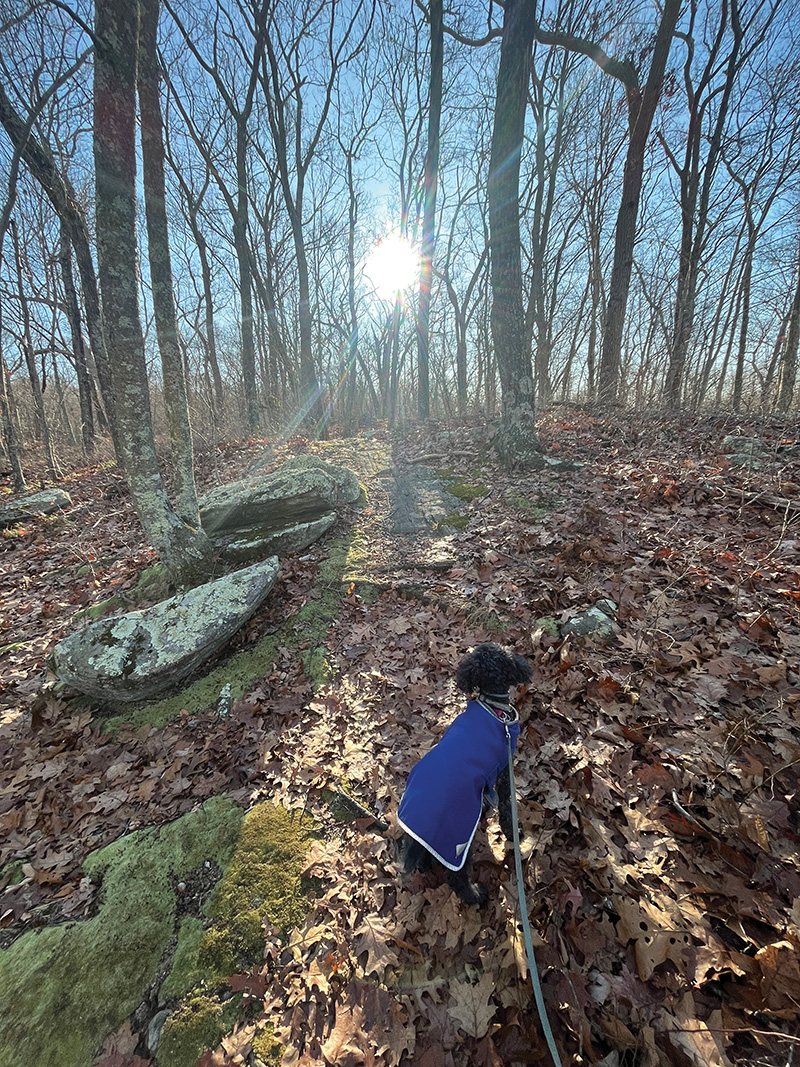
So, I nipped into these woods late on a chilly Saturday afternoon, as the sun dropped low and dead beech leaves, still clinging, seemed to glow. That day I noticed a rack of icicles on a ledge and trudged off-trail to look. Suddenly I remembered the time I’d taken my daughters to Killingworth’s Chatfield Hollow State Park, where I broke off two-inch-wide icicles from a tall ledge and handed them to them. The girls sat rigid inside their puffy toddler winter suits, one purple and the other pink, sticking their legs straight out as they sucked on the icicles. I wondered vaguely if this was the right thing for a mother to do, asking her toddlers to suck on icicles. And yet I felt so proud that they didn’t question me.
I snapped back to reality. The sun was setting. I heard the Essex Steam Train whistle in the distance. I continued up. So many oak leaves underfoot. Moss huddled bright green near rocks on the hill that had formed in visible layers. Some of them look like slabs of cake that were cut off and then started tumbling down the hillside. My joints spoke up, and I thought: you joints aren’t in charge here.
I now stood at the Deep River side’s highest point of land, where the blue-blazed trail meets the black-blazed trail. I did not have time for the black trail today, but I’d been down its lovely tumble into a small valley and up to another small ridge a hundred times. I used to argue with myself right here, saying that if I failed to explore that black trail I might not cover enough miles to have really worked my body. I don’t think that way anymore. Isn’t wisdom great? I closed my eyes and breathed in. Nothing that was bothering me before bothered me now. I was just a person making her way in the world and appreciating that I had come up here.
I turned around to watch the sun setting. On Valentine’s Day 2020, just before the pandemic would change our lives for a few years, my husband Nat and I trotted up here in our down coats and thick hats. It was our idea of a frugal date. We shivered and shared a few refreshments as the sun dropped low. We trotted out as the dark moved in.
At this high point I looked over at the flat, oval rock that for years balanced a second rock on top of it. The combination looked like a small car. Several years ago, someone moved the top slab and for a while a letterbox sat in the crevice. I haven’t been able to stand on top of the rock since, because the top rock is at a weird angle. So I decided to step over there and see if the letterbox was there. It wasn’t.
All the times I’d come here over three decades, I’d almost never run into a stranger. But I have inner dialogues with them when I see signs like dropped gloves—or the letterbox. When the letterbox was first there and the top rock askew, I asked out loud why someone would move “my” rock. With the letterbox gone, I realized I could put the top rock back the way it used to be. But then I thought, no, I probably couldn’t lift it. And anyway, this woods is not mine, and it was not up to me to move rocks or not move rocks. It’s the animals’ woods. The fox, deer, owls, turkeys, opossums, squirrels, and more all live in here, but mostly they hide from me as I come through.
Research has proven that animals are stressed when a human clomps by. The woods, owned jointly by Essex Land Trust and the towns of Deep River and Essex, are being connected to the Rattling Valley Ridge Preserve, thanks to the Deep River Land Trust trail crew, which I’ve been proud to help. I hope that these connected wild ways will be enough for the birds and the amphibians and the mammals.
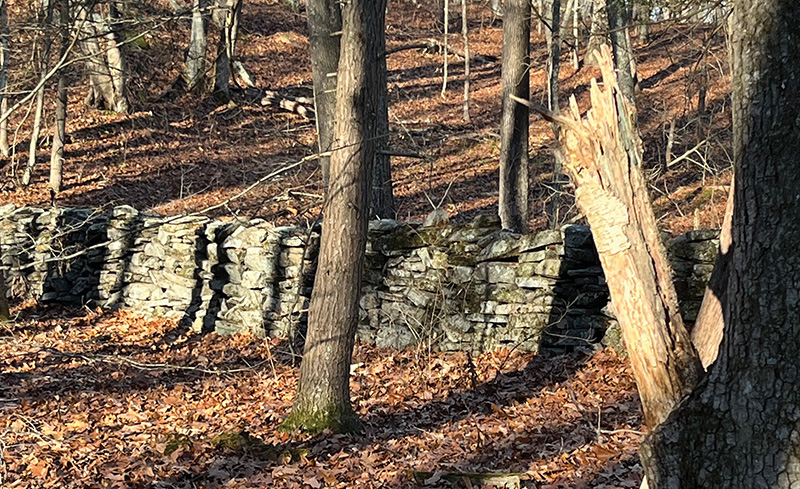
As I headed down to meet up with the yellow trail and hike out, I passed one of my favorite glacial erratics, a big, round rock just sitting there as if it were dropped in suddenly. A sapling that grows in front of it cast a striped shadow on the rock because of the setting sun. In the wintertime, the way the storms usually blow in, snow covers one side of this rock and the other side remains bare. Now it was just a gray hunk.
When I reached the bottom of the hill at a trail crossing called The Gap, I turned right. Just through a rock passageway, I knew, was an area that gets very wet in the spring, where frogs and peepers mate. Now the vernal pool looked like nothing more than a leafy forest floor. OK. It was dry. All right. It would be dark soon. I needed to go now.
Several days later, on a frigid morning at about 8:30 a.m., I returned with my little poodle, Talley. Tethered by leash, we walked into the woods and stepped over the railroad tracks onto the long-ago driveway-now-turned-to-wide-path. We climbed over a giant flattish rock in the path. I looked left to see if the stream was running yet.
I can gauge the progress of the seasons by whether I hear water. The streams run about half the year. Dry channels of late summer fill up over the cool months, first as little puddles dotting the beds, then as a moving current, and finally a gurgling one. I swung right on the wide path. Above the streambed rose the enormous rock ledge, now spotted and striped where morning light played with branch and tree shadows. I thought of the way early sun and late sun felt the same to me on cold days.
The woods had brought me back, and I would be back. Again and again.
Christine Woodside is the author of three books, including a wilderness memoir Going Over the Mountain, and the longtime editor of Appalachia journal. She writes from a tiny office in downtown Chester and lives in Deep River, Connecticut.
Resources
Find a map for Canfield-Meadow Woods Nature Preserve at essexlandtrust.org/preserve-profiles/.