
 This article appears in the Spring 2026 issue

Historic Deerfield
By John Burk
On Old Main Street in the village center of Deerfield, Massachusetts, the meticulously restored buildings of Historic Deerfield line a picturesque, tree-shaded thoroughfare. Each property has a unique and often complex story that relates to the history of the Connecticut River valley and makes for a wonderful outing later this spring, summer, or during fall foliage season.
Though peaceful today, Deerfield was the site of considerable turmoil in the colonial period. Settled in the early 1670s on the northern frontier of England’s colonial territory, Deerfield suffered from geographic and economic isolation in its early years. The village endured devastating attacks during King Philip’s War in 1675 and Queen Anne’s War in 1704 (the so-called Deerfield Massacre), but settlers persisted. Stories and legends from both conflicts generated considerable interest from early historians and travelers that helped motivate efforts to preserve the historic site you see today.
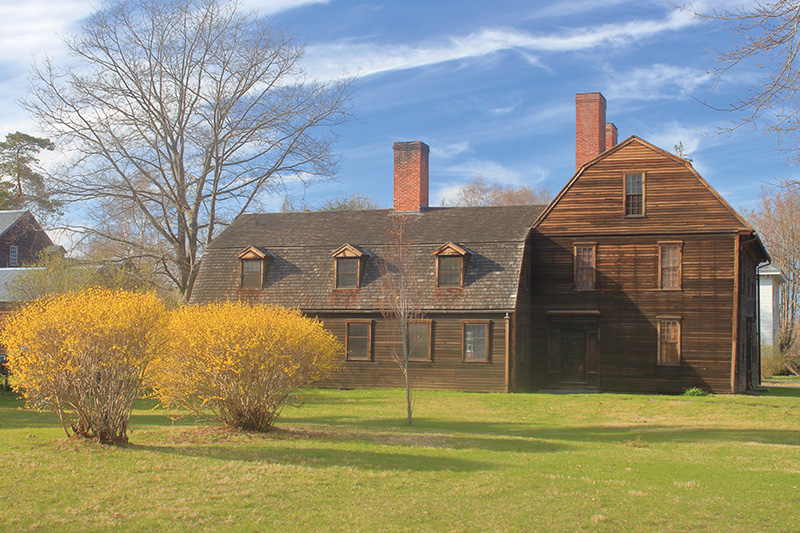
Historic Deerfield’s Ashley House, built in 1734, was home to Reverend Jonathan Ashley, the town’s minister for nearly 50 years and an ardent British loyalist. Photo: John Burk Photography.
During 2026 and early 2027 Historic Deerfield is commemorating the 250th anniversary of the Declaration of Independence with a variety of exhibitions and events about the War for Independence. Three new displays in the Flynt Center of Early American Life showcase images of the Revolution, political divisions of Deerfield residents, and clothing and fashion of the era. Other planned activities include themed walking tours, outdoor plays based on events in Deerfield during the Revolution, and a recreation of a tea party held by British loyalists at the Ashley House in 1774.
While visiting Historic Deerfield and the village last spring, I learned firsthand about architecture, trades, business, material cultural, and daily life. I toured buildings with a variety of styles, ranging from early colonial clapboard homes to stately brick houses of the Federal era. Colorful blooms of magnolias, forsythias, and tulips added a seasonal atmosphere to the properties.
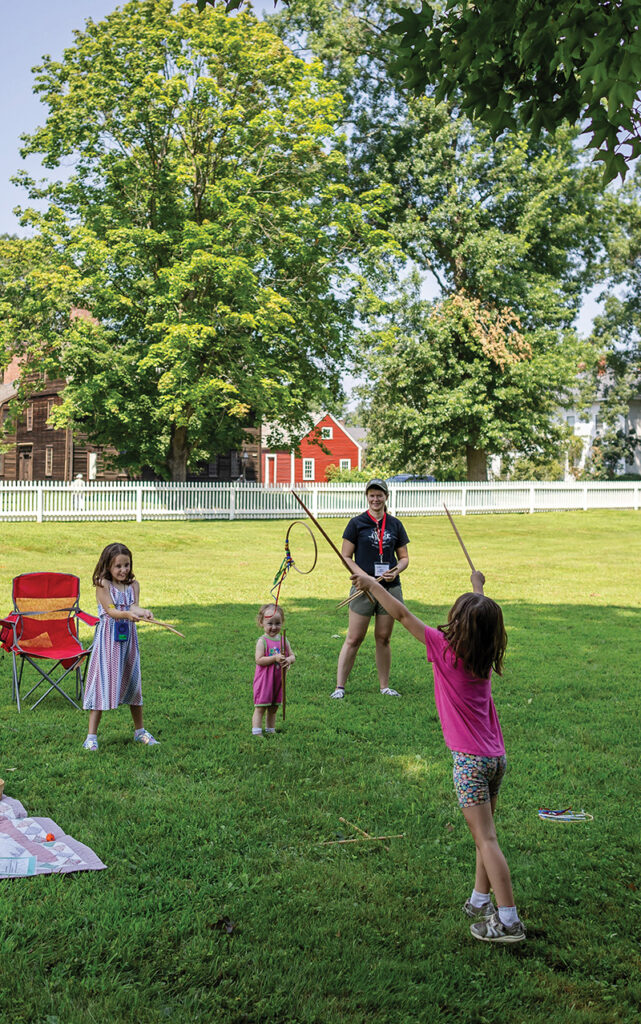
Programs and activities for all ages are part of the visitor experience at Historic Deerfield. Photo: Historic Deerfield.
Established in 1952 to preserve the village and the heritage of the Connecticut River valley, Historic Deerfield encompasses 12 houses, the Flynt Center of Early American Life, the Deerfield Inn, and other attractions. In addition to Historic Deerfield, the town’s historic district includes more than 50 buildings under various ownership, including Deerfield Academy, the Pocumtuck Valley Memorial Association, and the Bement School.
During the early 1670s colonial settlers established homes and farms along Old Main Street, which extends through fertile meadows near the confluence of the Deerfield and Connecticut rivers. The village’s original configuration has remained largely intact for more than 350 years.
After its tumultuous beginning, Deerfield became a center of agriculture, commerce, and education in the mid-18th century. Elaborate homes and fine furnishings reflected the village’s prosperity. Deerfield Academy, a prestigious boarding school with a large campus near the center, opened in 1799.
The founders of Historic Deerfield, Henry and Helen Flynt, became enamored with the village when their son enrolled at Deerfield Academy in 1936. Inspired by Colonial Williamsburg in Virginia, they purchased, restored, and refurnished buildings during the mid-20th century.
Situated at the village center, the Hall Tavern is the starting point for visitors to Historic Deerfield. One of four buildings moved to Old Main Street from other towns, it was built around 1760 in Charlemont, roughly 20 miles northwest. The structure houses a museum and offers seasonal open-hearth cooking workshops. From there, visitors can head either north or south on Old Main Street to tour attractions, such as the Wells-Thorn House, Dwight House, and the Ashley House, that offer a sampling of the architecture and people of Deerfield from colonial times through the 19th century.
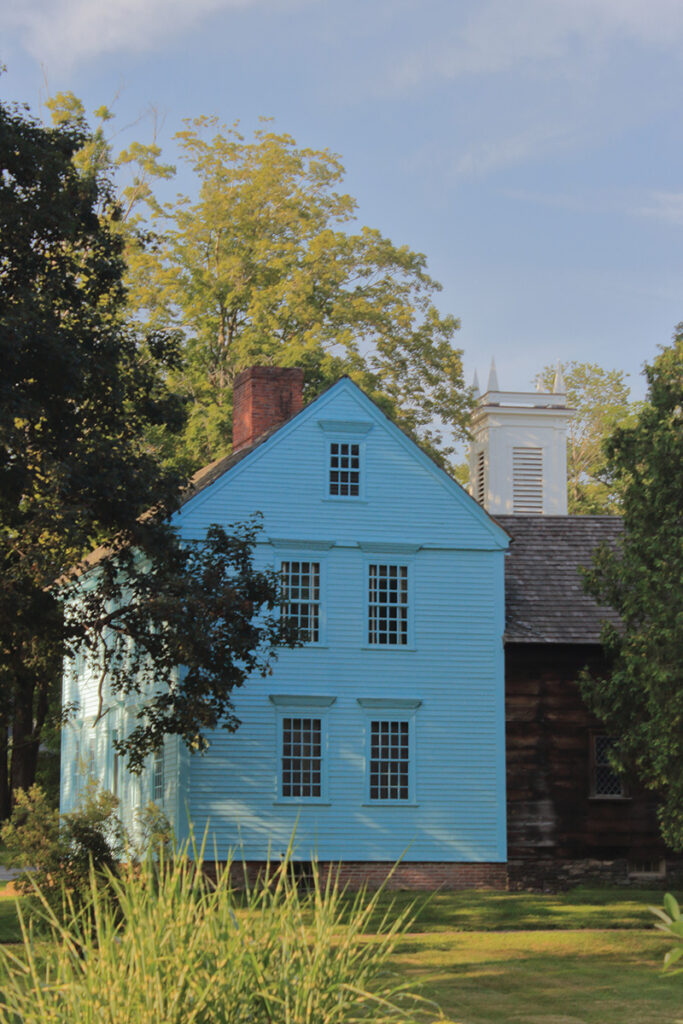
The Wells-Thorn House at Historic Deerfield. Lucy Terry Prince, the first known African American poet, lived here enslaved to Ebenezer Wells. Photo: John Burk Photography.
The first known African American poet, Lucy Terry Prince, lived at the Wells-Thorn House while enslaved to original property owner Ebenezer Wells. She composed “The Bars Fight” after the final Native American attack on Deerfield in 1746. You’ll see furnished rooms and artifacts portraying the progression of life in Deerfield from the frontier period to the mid-19th century and the development of material culture in the Connecticut River valley. A lawyer named Hezekian Strong painted the house a surprising light blue in the early 1800s to draw attention to his practice. Paint was a symbol of affluence, and the color today makes it a popular landmark for visitors.
Formerly a fashionable residence of downtown Springfield, Massachusetts, the Dwight House was built in 1754 by Josiah Dwight, a wealthy Connecticut River valley merchant. After the Flynts learned of plans to demolish the home, it was relocated here in 1954. The photogenic white-and-red structure houses the Apprentice’s Workshop, a demonstration area and learning space that provides interactive experiences in the production of textiles, woodworking, and ceramics.
Constructed in 1734 at the northern end of Old Main Street, the Ashley House represents the surge in building that occurred when Deerfield prospered during the 18th century. Reverend Jonathan Ashley, Deerfield’s minister for nearly 50 years, was an ardent British loyalist whose beliefs clashed with local supporters of the Revolution. The interior showcases furnishings owned by the “River Gods,” aristocrats who governed Connecticut River valley towns during the 17th and 18th centuries. The first restoration project completed by the Flynts, it opened to the public in 1948.
Visitors also enjoy displays at the Flynt Center of Early American Life, a state-of-the-art museum that showcases Historic Deerfield’s diverse collections. In addition to the new exhibits about the American Revolution, you’ll see galleries on the second floor of decorative arts such as furniture, clocks, powder horns, Chinese porcelain, and pottery.
If you’re ready for some time outside, the Channing Blake Path offers perspectives of Deerfield’s setting and agriculture heritage. From a trailhead next to the Moors House on the west side of Old Main Street, the route leads past a working farm to the Deerfield River and views of the Shelburne Hills, Pocumtuck Ridge, and meadows. Before European settlement, the Pocumtuck and their ancestors cultivated the fields for thousands of years.
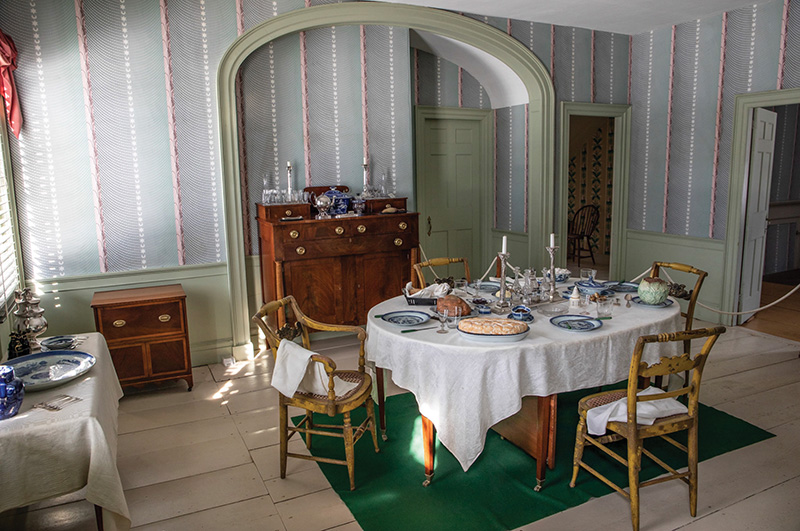
Historic Deerfield’s Hinsdale and Anna Williams House is a grand Federal mansion, built in 1730 and remodeled in 1816. French scenic wallpaper depicting Venetian scenes remains. Photo: Historic Deerfield.
Hungry? A popular destination for travelers since 1884, the iconic Deerfield Inn is a great base for exploring Historic Deerfield and the village. The inn was one of the first renovation projects completed by the Flynts. Amenities include 24 guest rooms and dining at Champney’s Restaurant and Tavern.
John Burk is a writer, photographer, and historian from western Massachusetts whose credits include books, guides, and articles in nature and regional publications.
When You Visit
Getting There
From Interstate 91 in Deerfield, take exit 35 (from the south) or exit 36 (from the north). At the junction of US 5/MA 10 and MA 116 near exit 36, follow US 5/MA 10 north for 4 miles. Turn left at a sign for Historic Deerfield then bear right at the next intersection and continue to the Hall Tavern (80 Old Main Street).
Hours and Admission
Historic Deerfield is open from 9:30 a.m. to 4:30 p.m., Wednesday through Sunday and Monday holidays, from early May through November. During the winter and early spring, the Flynt Center is open weekends, 9:30 a.m. to 4:30 p.m. Admission is $20 for adults, $5 for youth 13–17, free for children.
During the season, hourly tours are available at some houses; others are open for self-guided visits. Visitor guides and listings of daily activities are available at the Hall Tavern and online (historicdeerfield.org). Allow at least one full day if you plan on touring multiple houses. Visitors can view the buildings at any time from Old Main Street, which is a public road.