
 This article appears in the Spring 2026 issue
 The Belding Wildlife Management Area
Story and Photos by Ed Mitchell
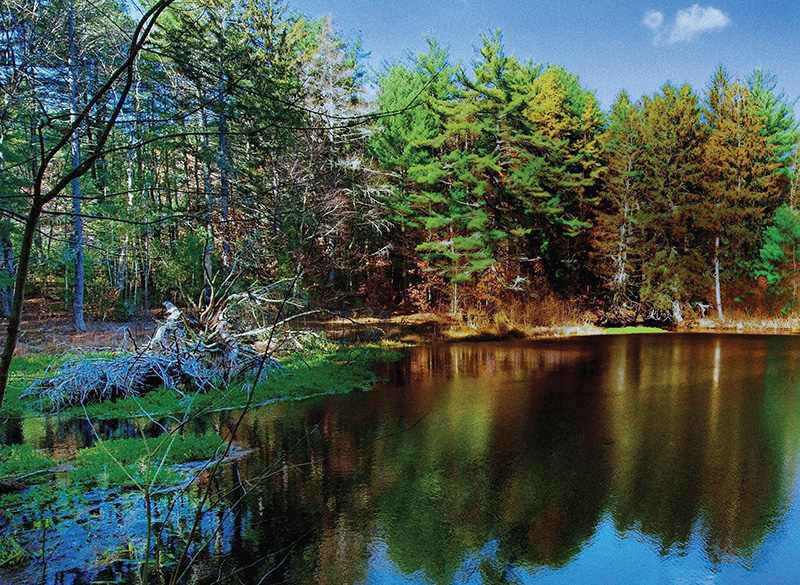
A section of the Tankerhoosen, Belding Wildlife Management Area. Photo: Ed Mitchell.
Awhile back I got an invitation for a guided tour of the Belding Wildlife Management Area (WMA). Gracing the quiet hills of Vernon, Connecticut, the Belding WMA is a nature preserve, kindly donated to the State of Connecticut by the Belding Family in 1981. Through the heart of this nearly 300-acre parcel runs the Tankerhoosen River, a tributary of the Connecticut River. In its serene waters reside wild brown and brook trout, prompting the state in 1993 to make this stretch of river Connecticut’s first Wild Trout Management Area (WTMA). The state now has 45 of them.
At a picnic table in the preserve, I met up with my guides. Seated across from me was Bill Hyatt, retired Bureau Chief of Connecticut’s Bureau of Natural Resources, and Jane Seymour, a Connecticut DEEP (Department of Energy and Environmental Protection) wildlife biologist and steward of the Belding WMA. Honestly, you could not hope for better chaperones. I opened by asking Jane to provide me with an overview of the area. “The Belding WMA has 282 acres of diverse habitat,” she explained, “ranging from old-and-new forests, to streams, ponds, meadows, old fields, vernal pools, each of them managed to offer a home for native species.”
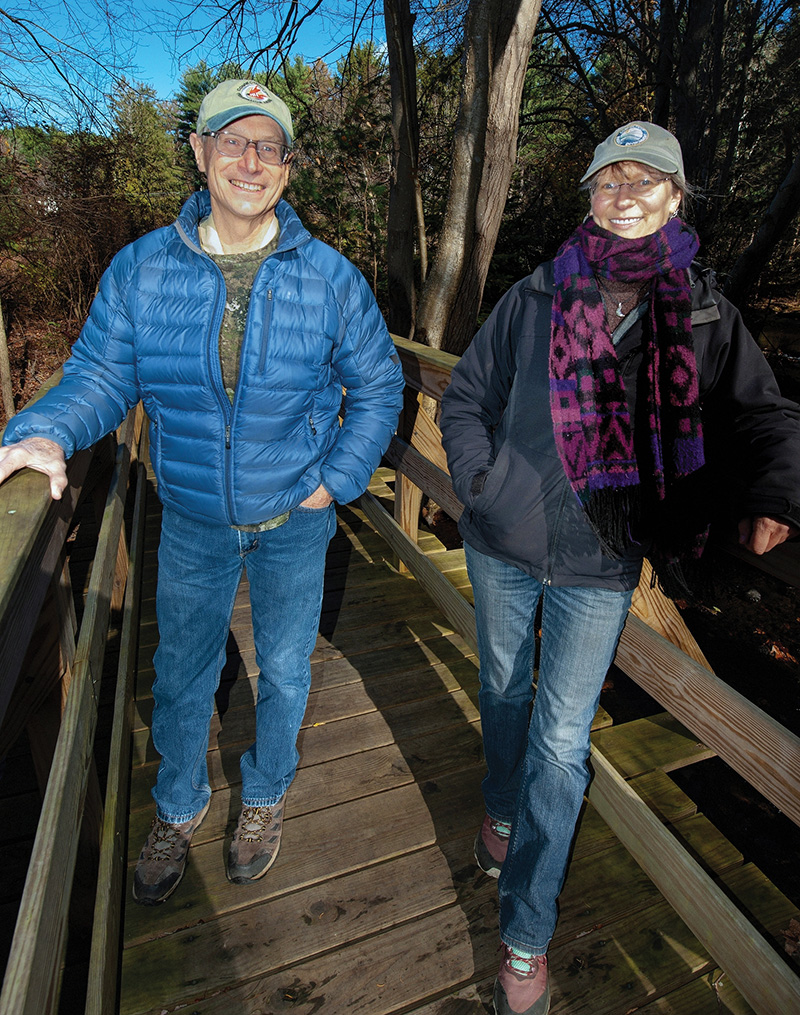
Bill Hyatt (L), retired Bureau Chief of CT Bureau of Natural Resources and Jane Seymour (R), a CT DEEP wildlife biologist and steward of the Belding Wildlife Management Area. Photo: Ed Mitchell.
Pointing to the surrounding land, she continued. “For instance, right next to us is the Wildflower Meadow. Here we planted native wildflowers and grasses for a very important reason. They are essential because most of our native plant-feeding insects evolved feeding on native plants. Caterpillars of moths and butterflies are an example.”
Already I was learning a good deal about the effort and skill required to manage a preserve. “These insects are a major component of the wildlife food web,” Jane continued. “Nearly all of our terrestrial birds raise their young on insects. To promote native plants, we continually remove nonnative invasive plants, such as mugwort and Asiatic bittersweet, which not only outcompete native plants, their presence diminishes food for indigenous plant-feeding insects, which in turn diminishes food for birds and other wildlife.”
From the meadow, the three of us took a walk to a wooden bridge over the Tankerhoosen. Peering over the railing, I got my first view of this river. Under a canopied forest, it wound, small and secluded, through a sheltering woodland. Turning to Bill, an authority on this river, I asked him to share his thoughts. “The Tankerhoosen provides excellent habitat for wild brown and brook trout. Browns are the most abundant species; recently brook trout numbers have waxed and waned. Fed by upstream springs and shaded in the summer, the river’s water temperature is ideal throughout the year. For instance, 2025 was one of the hottest summers on record, with some Connecticut towns topping 100 degrees. Yet even on the warmest days, the river flowed well and never exceeded 68 degrees.”
Knowing Bill had fished the Tankerhoosen for years, I asked for some angling advice. “First off,” he said, “when you fish any WTMA, be sure to read the rules. The Tankerhoosen is catch-and-release only, with a single barbless hook fly or a lure. And nearby Railroad Brook is a WTMA, as well. Expect beautiful wild trout averaging five to eight inches, with occasional trout of ten inches.”
Digging deeper, Bill revealed more secrets to success. “The fishing is challenging,” he replied with a grin. “Wild trout are shy. Believe me, their caution is going to test your skill. Spend more time approaching the water than actually casting. Remain quiet and low, staying back from the water to hide your silhouette. Realize that your first cast to any spot is typically your best chance, and often your only chance, to hook a fish before they spook. Stealth is the name of the game.”
Ready to learn more, I asked Bill about tackle, best flies, and best times to fish the Tankerhoosen. “For the most part I use a 6.5-foot 2-weight fly rod. And because of the thick cover, ‘bow & arrow’ casts are often required. [See my column about bow & arrow casts in the Spring 2024 issue.] Presentation is more important than fly pattern. Still, I like small wet flies and small bushy dry flies. And I recommend fishing early and late in the day, with June often the best month. Lastly, wear waders even if you don’t expect to be in deep water. Waders help avoid ticks, which are abundant in the area.”
With the bridge behind us, we headed to another section. As we ambled through the forest, Jane looked up for a moment, pointing out more management efforts underway. “We removed non-native trees to encourage native plants and grow new forest, both of which afford a haven for birds and other wildlife,” she explained.
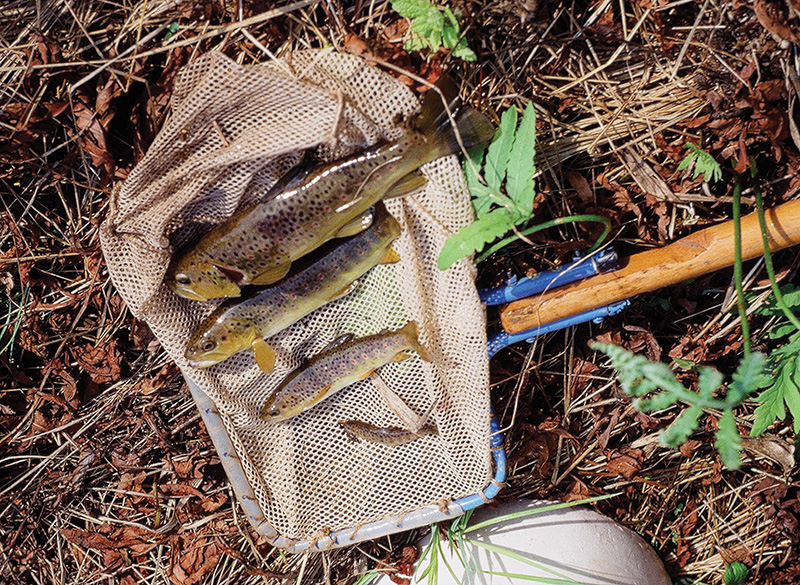
Trout caught and released as part of a DEEP trout survey. Photo: Bill Hyatt.
Further on, Jane informed me that the Belding family not only wanted the preserve to protect wildlife, but to provide environment education as well, especially for young people. To that end the preserve coordinates with schools in Vernon providing field trips for third and fourth graders to educate them about wildlife and habitat. “We train high school students to assist in these field trips. And some of them have gone on to pursue careers in natural resources,” Jane noted with pride.
As my tour concluded, I couldn’t help but think how important places like Belding WMA truly are. In the last 100 years, the population of the earth has quadrupled. There are now 8 billion of us; the population grows each day. That explosion is putting immense pressure on wildlife and our natural resources. And make no mistake, it is also pressuring our lives as well. A visit to places like Belding offers a respite, a chance to head outside, to breathe deep, and to sidestep our frenzied lives. It’s also a vivid reminder that our future and that of the animal kingdom are forever interwoven. We both evolved from the same soil. We both need clean water, clean air, proper nutrition, and a habitat free of toxins. We both want to survive. Personally, I can’t wait to come back and test my skills in the Tankerhoosen.
Ed Mitchell is the author of four books on fly-fishing and has written for many magazines. He has over 50 years of experience in both fresh and saltwater fly-fishing.
Belding Wildlife Management Area
portal.ct.gov/deep/wildlife/wildlife-mangement-areas/belding-wildlife-management-area
Connecticut Wild Trout Management Areas
portal.ct.gov/deep/fishing/fisheries-management/wild-trout-management-areas