
 This article appears in the Spring 2026 issue
A Complicated
VICTORY
The Fight for the Farmington River
By Eric D. Lehman
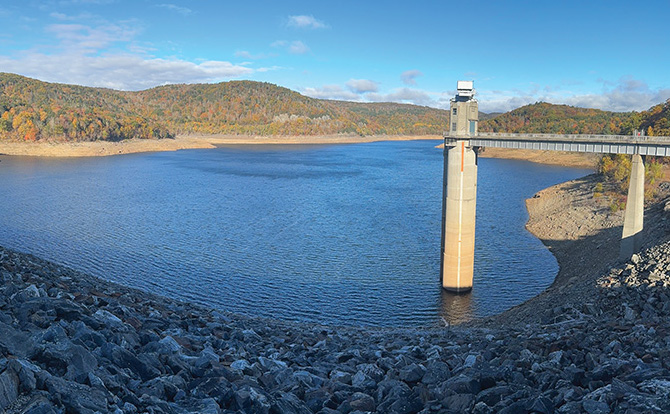
The tower at Colebrook River Lake Dam is 243 feet tall. The vertical white line marks the elevation in feet above sea level. The reservoir level in this photo, taken on October 17, 2017, is 641.1 feet. The elevation of 708 feet is considered by the United States Army Corps of Engineers (USACE) to be the normal or permanent pool for flood risk management. Photo: Mike Beauchene, CT DEEP.
Upstream from the Old Riverton Inn, deep in the pine forests of northwest Connecticut, the West Branch of the Farmington River is dammed not once, but twice, as it tumbles out of the Berkshire Hills. First comes the Goodwin Dam, forming the smaller West Branch Reservoir. Just beyond it looms the Colebrook River Dam, which holds back the vast Colebrook Reservoir—also known as Colebrook River Lake—stretching into Massachusetts. On sunny days, sailboats and motorboats dot its surface, their occupants enjoying the calm expanse.
But beneath this tranquil scene lies a years-long controversy over water rights, environmental stewardship, and the future of one of New England’s most beloved rivers.
Like all river systems, the Farmington River watershed is managed by a mosaic of public and private interests that stretches from Western Massachusetts to Windsor, Connecticut. These include the US Army Corps of Engineers (USACE), which manages flood control and national security at Colebrook Dam; the Metropolitan District Commission (MDC), a quasi-public agency that has overseen drinking water for the Hartford area for more than 100 years; and the Farmington Valley Power Company which operates a hydroelectric station at Rainbow Dam in Windsor.
In Connecticut, stakeholders include state agencies like the Department of Energy and Environmental Protection (DEEP) and Department of Public Health (DPH); the local governments of Colebrook, Hartland, Barkhamsted, New Hartford, and Canton; conservation groups like Farmington River Watershed Association (FRWA), Rivers Alliance of Connecticut, and Save the Sound; recreational and regulatory collaborations like the Farmington River Coordinating Committee and the Hogback Commission; and dozens of recreational businesses that depend on the river. This web of entities creates very complicated interactions and can lead to crises of various sorts.
The most recent crisis involves the MDC, which controls 14 percent of the Farmington River’s 609-square-mile watershed for drinking water purposes, along with managing 120 square miles around the northern section of the West Branch. The company’s involvement with the upper West Branch dates to a 1949 agreement granting it ownership of 6.5 billion gallons of water behind the Goodwin Dam. But when the Colebrook River Dam was built upstream in 1965, the usable capacity of the Goodwin Reservoir was reduced to 3 billion gallons. MDC continued to manage flow releases and hydroelectric operations of the Goodwin Dam, contributing 35 percent of annual maintenance costs under contract to USACE until the hydroelectric functions were decommissioned in 2017.
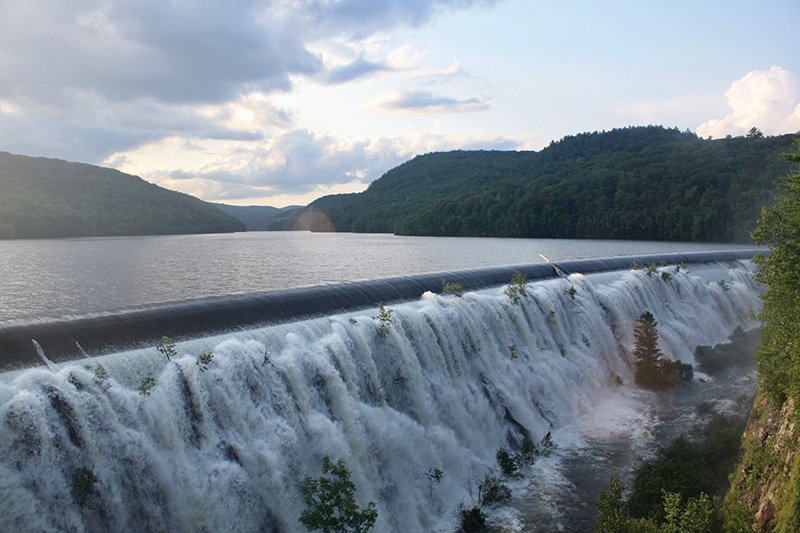
Goodwin Dam (also known as Hogback Spillway). Photo: Farmington River Watershed Assocation
In 2019 MDC made its last payment to the USACE and signaled it wanted to reduce its responsibilities in the watershed. That is where the story gets interesting.
The Colebrook Reservoir was conceived of as—and remains—a “backup” drinking water source, but has never been used for that purpose. MDC’s costs were rising for operations and maintenance. Naturally, once its contract with USACE ran out, the MDC wanted to cancel its oversight of both dams and the water release schedule.
In 2022 MDC formally petitioned to terminate its contract with USACE, citing both the lack of municipal or industrial use of the water and rising costs. It sought to relinquish oversight of the 10 billion gallons in Colebrook reservoir while retaining rights to the original 3.5 billion gallons in Goodwin Reservoir.
USACE denied the request, asserting the contract remained in force and that DEEP’s fisheries releases still depended on MDC’s Goodwin Dam operations. This began a disagreement that affected the entire watershed.
Just downriver from the dam, the Farmington River splashes and murmurs over smooth rocks, winding through small valleys, creating one of the best fishing and recreational destinations in New England. The fussy rainbow trout that anglers love to chase require certain water temperatures and flow to thrive. If the river, which had been managed since after World War II, becomes disrupted or polluted, it will cease to be a recreational paradise and experience floods and dry spells. It will also devastate farms and industries that depend on the managed, consistent flow of the river.
To maintain these conditions, the MDC was required to release a minimum issue of 50 cubic feet per second (cfs) from Goodwin Dam at all times, an additional release of all natural flows up to 150 cfs, release of any flows from the Otis Reservoir in Massachusetts, up to 21.7 billion gallons of releases due to requests by the Farmington River Power Company, and the CT DEEP fisheries releases from controlled pools in Colebrook Reservoir. Without these adjustments, the Farmington River’s flow rate could fall below 25 cfs during the long dry summers. The river had been artificially kept at a minimum of 50 cfs daily for decades.
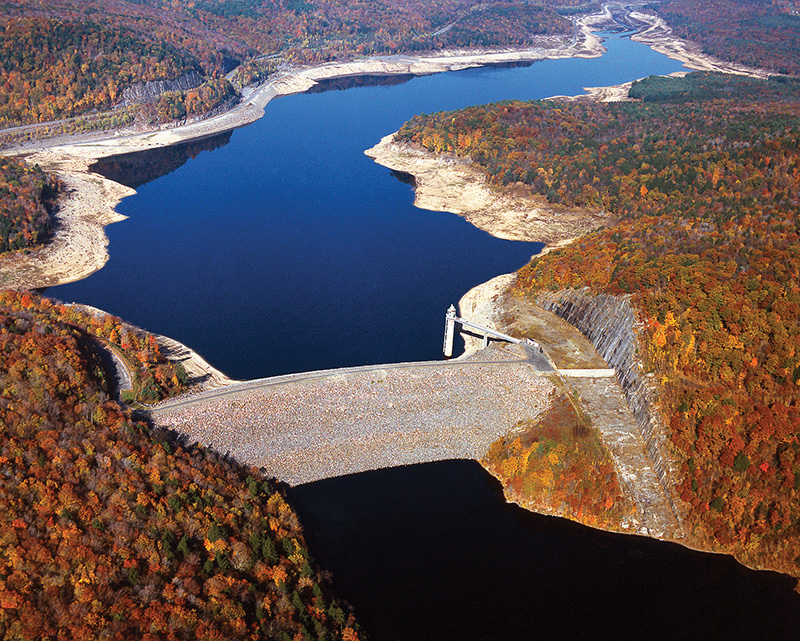
An aerial view of the dam and Colebrook River Lake. Photo: US Army Corps of Engineers.
On June 14, 2022, MDC sent a formal petition to change its contract, citing several Connecticut statutes and stating that the company had never accessed the water in the Colebrook reservoir “for municipal or industrial water supply sources.” From its perspective, this made perfect sense. As MDC stated, “Water customers throughout the greater Hartford community should not be forced to continue financing these agreements while receiving no benefits.”
Two months later, in August 2022, Matthew Coleman, USACE’s operations manager, Naugatuck River Basin, sent a letter stating that the water contract with MDC was still in force and that “The Connecticut DEEP has rights to request release from the approximately 1.6 billion gallons of water stored in the Colebrook Reservoir for fisheries conservation, which in turn must pass through and be released by the MDC’s Goodwin Dam.”
During the dry heat of that summer of 2022, however, the flow rates were not adjusted sufficiently in response to the drought, causing low water levels. Fish retreated to smaller tributaries or confluences, making them easier targets for anglers. The result was overfishing, and the DEEP considered banning fishing at certain times of year. The USACE couldn’t modify its operations because its flow releases are based on the other flood control dams on the Connecticut River. Regional conservation groups like Save the Sound, Farmington River Watershed Association (FRWA), and Rivers Alliance of Connecticut began to get worried.
Rivers Alliance of Connecticut focuses primarily on education policy and advocacy. It is involved in statewide policy, interacts with state agencies, and helps shape legislative policies. Executive Director Alicea Charamut, collaborating with Save the Sound and other organizations, had been following the situation on the Farmington River since 2019. The 2022 flow rates, she said, “raised alarms.”
“I don’t blame the MDC for wanting to get out of this agreement with the Army Corps of Engineers,” she told me. “They spend half a million dollars or more every year to maintain this dam when they’re not going to use the water.” But the conflict did cause problems, which for Rivers Alliance meant protection around the two reservoirs that were “providing very clean, high-quality water to the Farmington River,” she explained. “It is sort of an artificial cold-water habitat, but nonetheless, it’s cold-water habitat at a time when we’re losing that habitat through land use conversion and climate change.”
The Department of Public Health was the arbiter on MDC’s involvement because of its authority over public drinking water. It set a hearing for January 5 and 6, 2023. Save the Sound filed a successful “Request for Party or Intervenor Status,” arguing in part that finding in favor of MDC would lead to the elimination of state law protections over inactive drinking water sources, including those on watershed lands. Charamut testified that finding in favor of MDC’s request could jeopardize long-term water planning. The river’s erratic flow was already harming fish populations and recreational businesses. MDC voluntarily withdrew the request for a declaratory ruling and agreed to file an abandonment permit instead. This still required a DPH ruling, but carried less onerous legal hurdles.
In April 2023, DPH gave a ruling that carefully considered both sides of the issue. A denial of the abandonment permit (i.e., not allowing MDC to walk away), it noted, might be justified because of the possible need for additional high-quality drinking water supply sources above current projections due to future environmental stressors, population growth, economic development, or regulatory requirements. As it was, the impoundments of the West Branch were “less susceptible to potential contamination or negative impacts.” On the other hand, DPH recognized the lack of a specific need for the billions of gallons of water, the impracticality and cost of this source compared to others, the fact that any drought would also dry up Colebrook Reservoir, and the fact that 6.5 billion gallons would still be kept as an emergency source.
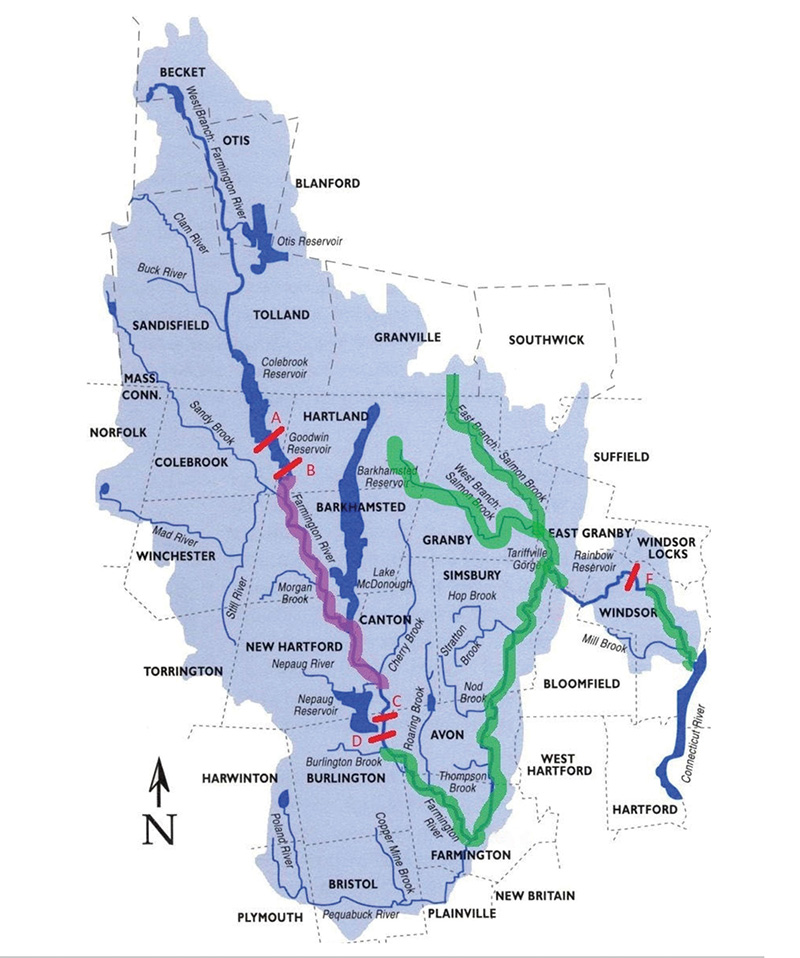
Map of the Farmington River showing the Colebrook (A) and Goodwin (B) dams on the West Branch near the Colebrook-Hartland town line. The purple section is the Upper Farmington River Wild and Scenic, and the green sections are the Lower Farmington River and Salmon Brook Wild and Scenic. Three other remaining dams are Upper Collinsville (C), Lower Collinsville (D), and Rainbow (F). The Farmington empties into the Connecticut at the lower right. Courtesy Mike Beauchene and FRWA.
Furthermore, a tentative agreement to protect the surrounding land owned by MDC was in the works (See sidebar). DPH granted MDC the abandonment permit subject to several reasonable conditions.
That summer, after DPH’s initial ruling but before DPH issued a formal ruling document, the river flow fluctuated again—from 50 cfs during dry spells to 1,300 cfs after heavy rains. “There’s a lot of coordination and decision-making that goes into these flows behind the scenes,” says Charamut. “And that was no longer being done effectively.” The confusion around decision-making was obviously not good for the fish, the kayaking and tubing companies, or the general health of the river.
Nearly a year later, on May 14, 2024, the Connecticut General Assembly passed Public Act No. 24-13, empowering DEEP to coordinate water releases in consultation with MDC. This marked a turning point: for the first time, DEEP would manage river flow not just for fisheries, but for overall river health. Eight months later, in early 2025, DEEP submitted a draft report to the public on recommended courses of action for management. After gathering public feedback in summer 2025, DEEP released its final flow management plan. The plan aims to balance ecological needs, recreational use, and emergency preparedness.
“This flow plan is kind of a miracle,” says Aimee Petras, executive director of the FRWA. “It’s been a six-year process—we didn’t know where we were going in 2019. Now, Connecticut DEEP has a bigger slice of the pie, and that’s a good thing.” Nick Salemi, communications administrator at MDC, agrees: “The final report reflects a thoughtful and science-based approach to river flow management. We’re proud our team helped shape a clearer path forward.”
Who defines the public interest? Water customers or conservationists? The farmers or the kayakers? What about the companies that serve them? Understanding what the public interest is and protecting that interest is the ostensible job of local, state, and federal government. But when it is entangled in the complex web of public and private partnerships that make up the real world, ordinary people—not to mention animals, plants, and rivers—often get lost in the shuffle. Hopefully, in this case, the solution will satisfy everyone and protect both private interests and public welfare.
In the meantime, the planned solution seems to be a victory. Not a dramatic victory, but a quiet compromise, a continuing if unsteady marriage of public oversight and private responsibility. It is a reminder that protecting our rivers requires vigilance, collaboration, and a willingness to navigate practical and ethical complexity. It is a hopeful sign that we might look forward to a time when the Farmington River flows without disruption, steadily, cleanly, and quietly through the lives of thousands who depend on it. When no one needs to worry about the health of the river at all—that will be the real victory.
MDC Agrees to
Conservation of 5,200 Acres
Companies that supply us with drinking water are the largest open space landholders in Connecticut. This land is protected to ensure water quality, with a side benefit of limiting development and other damaging activities. And yet, these protections are not permanent. When MDC sought an abandonment permit for the water supply of the Colebrook River Reservoir in early 2023, this theoretical danger suddenly became concrete for some of the wildest and most beautiful land in the state.
Several nonprofits sprang into action. On June 16, 2023, MDC signed a Memorandum of Understanding with Save the Sound and the Northwest Connecticut Land Conservancy (NCLC) to negotiate the terms and conditions of a conservation easement of 5,200 acres of land around Colebrook River Reservoir, including 4,000 in Connecticut and 1,200 in Massachusetts. This agreement was designed to make sure that the lands could not later be privately sold and developed and protect the land’s ecological and public recreational value.
Catherine Rawson, executive director of NCLC, said that the permanent protection of these lands was “exceptionally important to the region’s conservation future” and that “the vision and partnership of MDC and the state’s leading environmental organizations” would make sure that the land surrounding the state’s largest untapped drinking water reservoir would be “protected for the public benefit forever.”
NCLC agreed to purchase the easement for $1 million. It completed its fundraising this year with support from the Connecticut State Bond Commission, The Nature Conservancy, and Connecticut Land Conservation Council.
“These acquisitions are a big win for our environment and communities,” Rawson said. “We look forward to continuing the work necessary to safeguard these extraordinary lands and ensuring they remain a source of clean water, thriving ecosystems, and access to nature for generations to come.”