
 This article appears in the Winter 2025 issue

Maggie Jones on Barred Owls
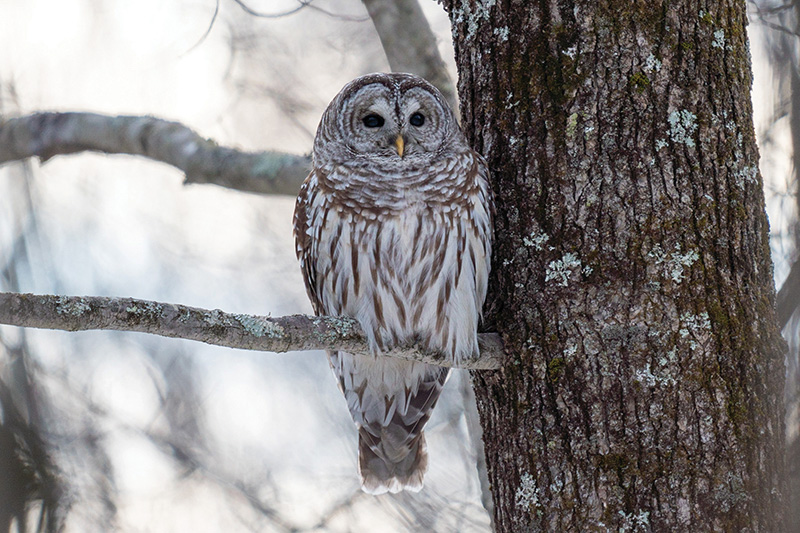
Barred owl. Photo: Frank DiNardi.
As part of my investigation of Frank DiNardi’s experience photographing barred owls in the last issue (“Barred Owls in the Backyard,” Fall 2025), I interviewed Maggie Jones, a landscape ecologist/consultant, for this follow-up story.
Barred owls may look lovable, but don’t be fooled. “Don’t let their adorable puffy heads and big, dark, watery eyes fool you,” Maggie Jones said, “Barred owls are badass. They are fierce.”
Jones served as executive director of the Denison Pequotsepos Nature Center in Mystic, Connecticut, for 27 years. “I know firsthand,” she said. “I worked with barred owls, from newly hatched young through adults for over 30 years, as a state- and federally-licensed wildlife rehabilitator at the nature center.”
Barred owls are the “nocturnal counterpart” of red-shouldered hawks, Jones noted. “They share the same ecological niche, favoring wooded wetland habitats.” In fact, she said, the two species often nest near each other. “Barred owls will even wade in vernal pools and shallow ponds hunting for frogs, salamanders, and snakes. They also eat mice, rabbits, bats, flying squirrels, young raccoons, and sleeping birds.”
I asked Jones which features on their head, wings, and feet make them effective hunters. While they lack decorative, mostly expressive ear tufts, she said their head is designed for listening. It is shaped like a satellite dish with ears hidden at the side of the face. The ears are positioned off-center so they can detect sound above and below.
Their eyes are also important, working in concert with their ears, Jones noted. Barred owl eyes are big—about 70 percent of the skull (compared to 5 percent for humans), allowing for maximum light gathering between dusk and dawn. They also have a high density of rod cells at the back of the eye, allowing them to see detailed images in low light. Silent flight (fringed feathers that muffle sound) is another critical adaptation for hunting, Jones said.
The last arrow in this well-equipped raptor’s quiver is their feet. “All owls use their legs and feet as powerful weapons for hunting and defense. It is how they survive,” Jones said, adding, barred owl talons are extremely sharp and can crush prey with a force of 200-plus pounds per square inch.
Barred owls have adapted well to our human-dominated landscape and seem to nest wherever they can find a suitable cavity, like a nest box, hollow tree, snag, or chimney—and where there’s food. Great horned owls on the other hand, often take over open stick nests of ospreys and red-tailed hawks.
Barred owls mate for life, Jones confirmed, but will quickly replace a mate that dies. Pairs stay together through the breeding season to raise their young. They only have one brood per year. “I’m sure some pairs breed again the following year (or years). It is all about survival of the fittest and passing on the best genes,” Jones emphasized.
“Owls are indeed devoted parents,” Jones said. “The female does most of the incubating, but once the eggs hatch, the male is the main provider, and young owlets quickly learn to recognize when he brings food back to the nest.” As the owlets grow, the female helps with the hunting. After a few weeks, Jones said the chicks start “branching,” that is, moving further from the nest. Once they leave the cavity (or box), they do not go back in. Jones said they are exceptionally good climbers, using their beaks and sharp claws to climb up out of harm’s way if they end up on the ground before they can fly.
As the chicks grow older, Jones said the parents continue to feed, watch, and protect them. “We had barred owls in a nesting box outside the nature center. It was entertaining to watch the parents demonstrate hunting techniques to the fluffy owlets. Often the adults would hunt during the day, suddenly swooping down to snatch a snake or chipmunk. Eventually, its ‘tough love’ for the young owls, and they are on their own,” Jones said.
“I have seen sibling owls working together for a couple of weeks after fledging (usually in July or August). Eventually they go their separate ways, wandering around looking for good habitat not already occupied by barred owls, finding mates, and establishing territories of their own,” Jones added.
While barred owls are skilled hunters and adaptable survivors, their populations, however—along with many other birds of prey—face serious risks from rodenticides used in eliminating mice arounds homes and businesses. These toxic chemicals can accumulate in their prey and eventually cause illness or death. Jones notes that rodenticides, or “rat poisons,” kill not only rats and mice but also birds, pets, and other predators that consume poisoned rodents. Hawks and owls are especially at risk, as they often bring contaminated prey to their young, she said.
I asked about alternatives. Snap traps work, Jones explained, but they must be set and checked regularly. She recommends deterring rodents by sealing cracks and entry points in your home, or by using high-frequency sound devices, herbal repellents, and even coffee grounds.
Barred owls aren’t welcomed everywhere. In September 2024, the US Fish and Wildlife Service proposed a highly controversial plan to shoot and kill more than 450,000 barred owls over the next 30 years in the Pacific Northwest where they are considered invasive. The agency argued the drastic measure was necessary to protect the native northern spotted owl, a threatened species with only about 4,000 individuals remaining in the region. Officials warned that without intervention, the northern spotted owl could be pushed to extinction by its more aggressive eastern cousin.
The proposal, dubbed “Hoot and Shoot” by locals, quickly drew opposition. In November 2024, Animal Wellness Action and the Center for a Humane Economy filed a lawsuit in federal court in Seattle seeking to block the plan. Opposition continued to grow, and by May 2025, 20 members of Congress—split evenly between Democrats and Republicans—urged Interior Secretary Doug Burgum to defund the billion-dollar program. “It’s an unprecedented assault on a North American native owl, and no government has ever proposed killing more than 100 raptors in any wildlife management project, ever,” said Wayne Pacelle, president and founder of Animal Wellness Action, in my June 2025 interview.
Since May 2025, two legislative resolutions—HJR 111 in the House and SJR 69 in the Senate—were introduced to block federal funding for the billion-dollar program. As of this writing in September 2025, neither of the bills have been voted on.
Bill Hobbs is a contributing nature writer for Estuary magazine and The Times newspapers of New London, Connecticut. He welcomes your comments at whobbs246@gmail.com.