
 This article appears in the Winter 2025 issue

Tracking Quabbin Reservoir’s
Winter Wildlife
Story and photos by John Burk
On a brisk February afternoon last winter, I set out to look for animal tracks at the northern end of Quabbin Reservoir in central Massachusetts. Conditions were ideal for tracking. A light coating of moist snow preserved details of the imprints and made for easy walking.
Quabbin Reservoir was built during the 1920s and 1930s as the primary water supply for the greater Boston area. Engineers chose the Swift River valley as the location for the reservoir because of its bowl-shaped topography, clean water, and light human population. The state took over four towns and several villages during the project, dislocating 3,500 residents.
The reservoir’s many sources include three branches of the Swift River, numerous streams and brooks, and seasonal water diversions from the nearby Ware River. The Swift and Ware rivers are headwaters of the Chicopee River, which occupies the Connecticut River’s largest tributary basin.
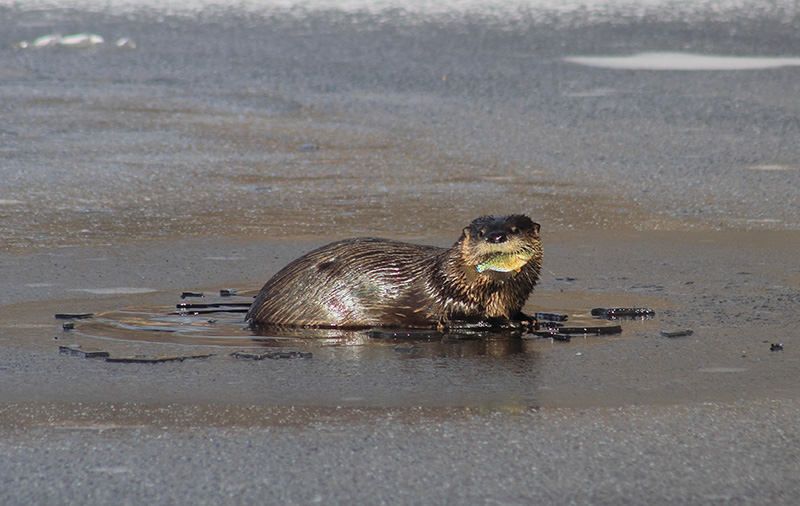
A river otter found a break in the ice to successfully catch a sunfish.
The Massachusetts Department of Conservation and Recreation’s Division of Water Supply Protection manages the reservoir and surrounding forests and wetlands. The property, which encompasses nearly forty square miles in portions of seven towns, is the largest expanse of protected land in southern New England. Many species of wildlife, including thriving populations of moose, bald eagles, and common loons, benefit from the diverse habitats.
More than fifty public access areas at numbered gates provide a multitude of options for tracking, wildlife watching, and hiking. Quabbin Park, at the reservoir’s southern end in the towns of Ware and Belchertown, has a visitor center, auto road, scenic lookouts, and a network of blazed trails. Other sections offer opportunities to explore off the beaten path. (Note: dogs and cross-country skiing are prohibited.)
Heading into the woods from the trailhead, I came across parallel tracks of two eastern coyotes. During the winter breeding season (late January to March), coyotes are highly active, even during daylight hours. Individuals disperse to search for mates, and pairs hunt and defend their territories.
Since arriving in central Massachusetts during the 1970s from the West, coyotes have thrived at Quabbin Reservoir because of their adaptability and the abundance of white-tailed deer and other food sources. Packs of coyotes often chase deer onto the ice, where they feed on stranded or fallen individuals.
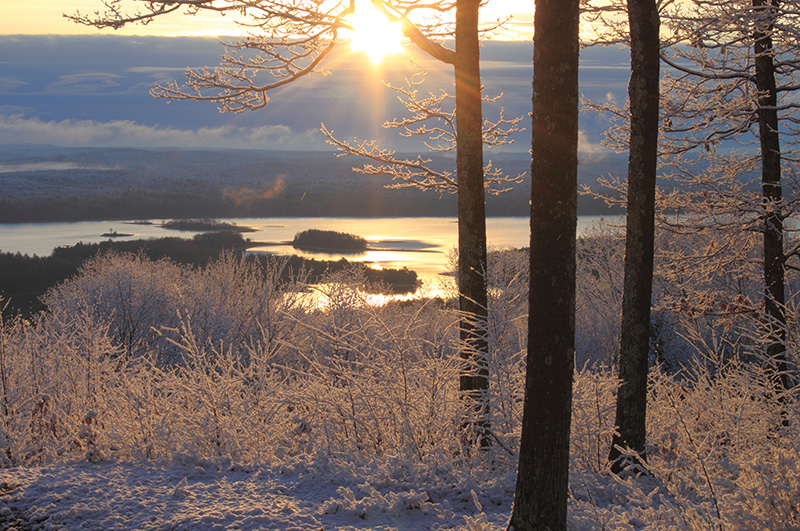
Sunrise illuminates a first snow at Quabbin Reservoir.
At the edge of a beaver pond, the trail of a bobcat wound past a marshy area, fallen logs, thickets, and a stone wall. The footprints of bobcats and coyotes both show four toes, but those of bobcats lack claw marks and are rounder in shape. Though secretive, bobcats are fairly common in the Swift River watershed. They often traverse rugged environs such as rocky hills, ledges, and swamps while stalking prey.
Snowshoe hares are an important food source for bobcats, coyotes, and other predators. They thrive in thickets, field edges, and other habitats that provide cover. Their large hind feet, which facilitate travel through snow, make imprints up to six inches long. Prompted by changes in daylight, the fur of the snowshoe hare changes from brown to white in winter.
In a nearby hemlock grove, body imprints and well-beaten paths revealed a wintering area used by white-tailed deer. The dense evergreen cover of hemlock forests, a crucial winter habitat for deer and other wildlife, buffers snowfall and provides insulation from cold temperatures and wind. Unfortunately, many hemlocks in the Quabbin Reservoir watershed have died from infestation with hemlock woolly adelgid.
Protected from hunting for more than fifty years, the deer population at Quabbin Reservoir grew to as many as fifty animals per square mile by the late twentieth century. After deer herds depleted young trees and understory vegetation, in 1991 officials implemented an annual hunt to control the population and promote a healthy, diverse forest that provides natural filtration for the reservoir and supports nesting birds, small mammals, and pollinating insects.
While passing several forest management sites on the next section of the trail, I saw numerous heart-shaped tracks of moose. One set included imprints made by an adult and what appeared to be two juveniles—likely twin calves. Habitats with regenerating vegetation provide crucial forage for moose, which feed on buds, twigs, bark, hardwood saplings, and needles of conifers during winter.
Quabbin Reservoir and the Ware River watershed preserve prime habitats and travel corridors for moose, which returned to the region in the late twentieth century after being extirpated through habitat loss and unregulated hunting. Although moose have decreased in northern New England because of infestations by ticks and other factors, for now the Massachusetts population appears to be relatively stable at 800 to 1,000 individuals.
On a causeway where the trail crossed Fever Brook, a smooth path marked the spot where a river otter slid down to the water below. Energetic and seemingly playful, otters often glide on their bellies when traveling through snow or over ice. Like other weasels, when otters run or bound their tracks often display clusters of three or four visible footprints. In winter they are often visible feeding at gaps in ice and in locations with partially frozen water.
Shortly after I turned onto a former town road to head towards the shore, I saw a barred owl staking out a clearing from a tall oak tree. Barred owls are often active during winter, especially when heavy snow or ice forces them to venture beyond their usual territories in search of food. Broad imprints of wings and feathers in snow reveal places where owls swooped down to attack prey on the ground.
As I approached the end of the road at the water’s edge, calls of ravens and crows echoed through the trees, and a large raptor circled overhead. Such activity often indicates that a kill site is nearby, and moments later I saw a deer carcass on the ice several hundred feet away. A coyote scampered into the woods with a bone.
When I stepped behind shrubby cover, a golden eagle, distinguished by its brown head, swooped down to feed. The sighting was an unexpected treat, as golden eagles are shy and rarely seen in Massachusetts. Individuals periodically winter at remote locations in Quabbin Reservoir.
Sunset was approaching, so I reluctantly left the scene and hiked back to the trailhead. By the next morning, when I returned with the hope of getting pictures in better light, the carcass had been largely picked over. A juvenile bald eagle and several crows bickered over scraps.
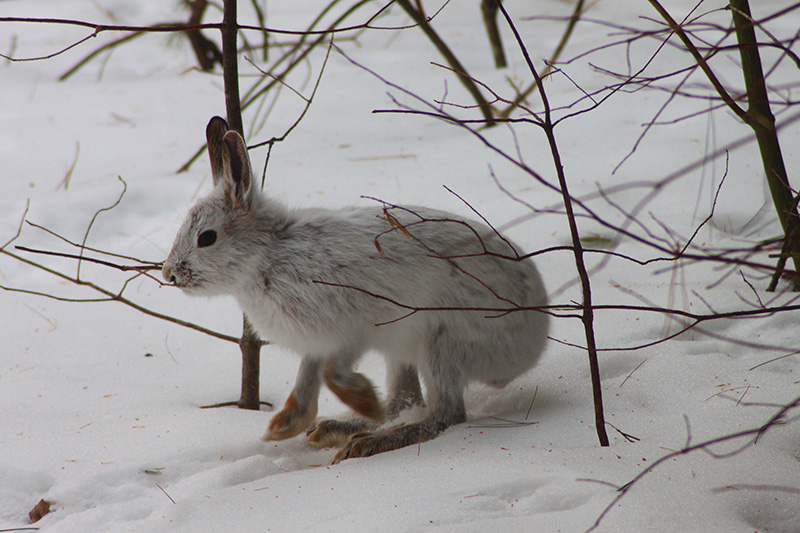
Snowshoe hare.
The bald eagle is Quabbin Reservoir’s best-known wildlife restoration story. Eagles disappeared from Massachusetts in the early twentieth century. In the 1980s 41 chicks from Michigan and Canada were released here. In 1989 two pairs successfully nested. More than 750 eagles have fledged in the state since that time, according to the Massachusetts Department of Conservation and Recreation.
During winter bald eagles often congregate at the reservoir to feed on fish in open water and on deer carrion left by coyotes. Prime viewing locations include Quabbin Park, where the Enfield Lookout offers a spectacular northerly view across the Swift River valley.
John Burk is a writer, photographer, and historian from western Massachusetts whose credits include books, guides, and articles in nature and regional publications.
Quabbin Park
100 Winsor Dam Road
Belchertown, MA
www.mass.gov/locations/quabbin-reservoir