
 This article appears in the Winter 2025 issue

This is the second in a series of stories about hydrilla. For an introduction, see “Hydrilla: The Nine-Headed Serpent in our Estuary Waters,” by Judy Preston, Fall 2020, and at https://www.estuarymagazine.com/2020/11/hydrilla/.
“Hydrilla is probably the most difficult of aquatic invasives to control,” says Alicea Charamut, executive director of Rivers Alliance of Connecticut. “And this particular strain found in the Connecticut River, hydrilla verticillata lithuanica, is hydrilla on steroids. If not addressed in its first or second growing season after it appears, it becomes very dense and spreads—fast. Some lake communities are considering restricting public access to their waters out of desperation.”
Hydrilla was first discovered in the Connecticut River near Glastonbury, Connecticut, in 2015, according to the Connecticut Agricultural Experiment Station (CAES), a quasi-public agency charged with coordinating hydrilla management in the state. It has been detected near the mouth of the river in Essex and as far north as Agawam, Massachusetts. Scientists fear it will continue to move north; it has already begun migrating into the tributaries of the Connecticut River. And now real progress addressing it is being threatened by uncertainty in federal funding, though state funding for Connecticut’s efforts is more secure for now.
The problem with hydrilla, Charamut explains, is “You can’t smother it, or pull it out (hand harvesting) because the fragments just move on and take hold elsewhere…the real evil being inaction. Doing nothing is just not an option.”
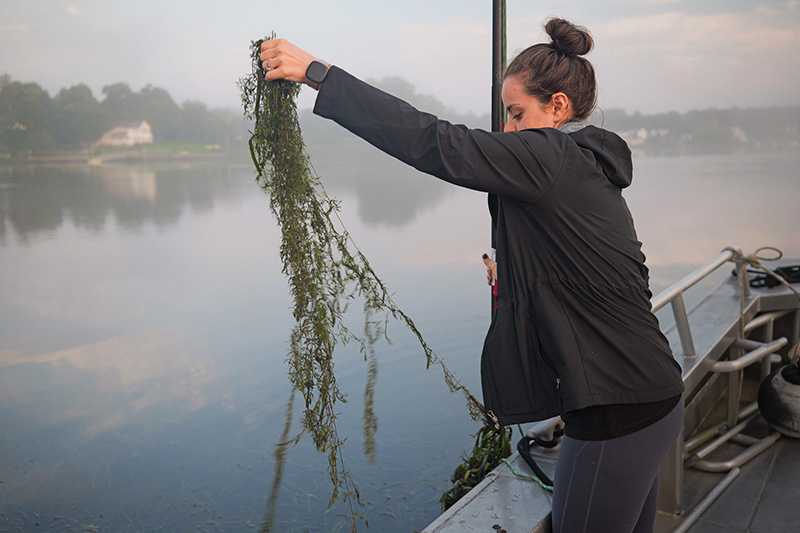
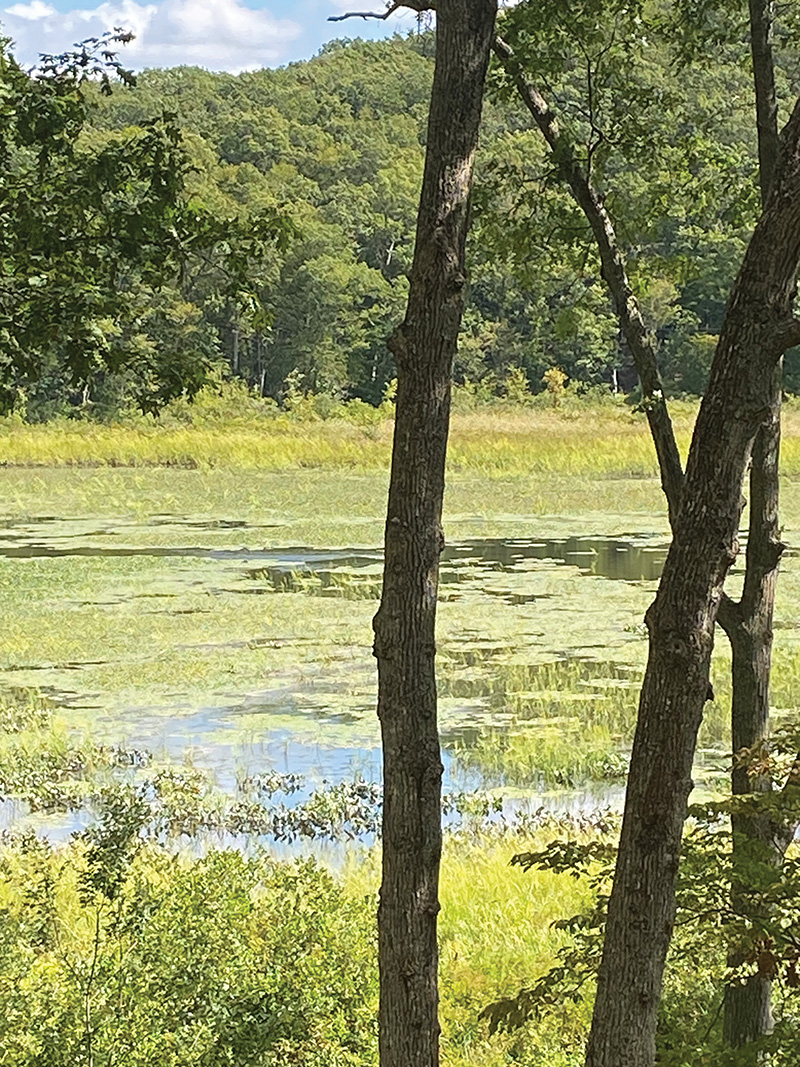
Above: Post Cove, Deep River, CT, showing hydrilla where native wild rice used to grow. Photo: Christine Palm. Below: Hydrilla pulled out of the Connecticut River in Essex in July 2024 by Connecticut River Conservancy staff during a macrophyte survey as part of Save the Sound’s Unified Water Study. Photo: Connecticut River Conservancy.
Kelly Beerman, the Vermont-based Aquatic Invasive Species Program Manager for the Connecticut River Conservancy (CRC), adds that the presence of hydrilla complicates management of other species. “For example, where mechanical harvesting works well on water chestnut, if hydrilla is also present you can’t use that method.”
Luckily for folks in the northern part of the watershed, Connecticut has been studying the problem for several years. They’ve found that, as with so many ecological problems exacerbated by climate change, hydrilla is a problem requiring both patience and urgency.
“Aquatic plant management is inherently a long-term endeavor,” says Dr. Jeremiah Foley, a research biologist with CAES. The State of Connecticut has created a non-lapsing account for CAES of $300,000 for this work. He and his team are working cooperatively with the US Army Corps of Engineers (USACE) which relies on federal funding to find effective treatments that will help manage hydrilla while not posing undue risk to humans or other forms of life.
Foley says that after years of assiduous research and multiple tests, his team is testing Procellacor (florpyrauxifen-benzyl). Using this herbicide, scientists have seen the presence of hydrilla reduced. Before the treatment, hydrilla covered about 60 percent of the trial location’s surface area. After application, that number was reduced to 5 percent.
But consistency is key. “This year and into the next, it will be important to measure reductions in the ‘seed bank’ (called turions). Sustained, multi-year treatments at a given site can, over time, diminish the turion bank and ultimately reduce the long-term impact of hydrilla.”
Last year, Foley points out, USACE, which received $6 million in federal funding in fiscal year 2023, $5 million in FY 2024, and zero in FY 2025 due to the ongoing budget impasse, had planned to establish approximately 14 demonstration sites, but this year that number has been reduced to only 2. In addition, it is relying on herbicides and dye left over from the prior year’s funding cycle, which has further constrained the total number of sites that can be treated.
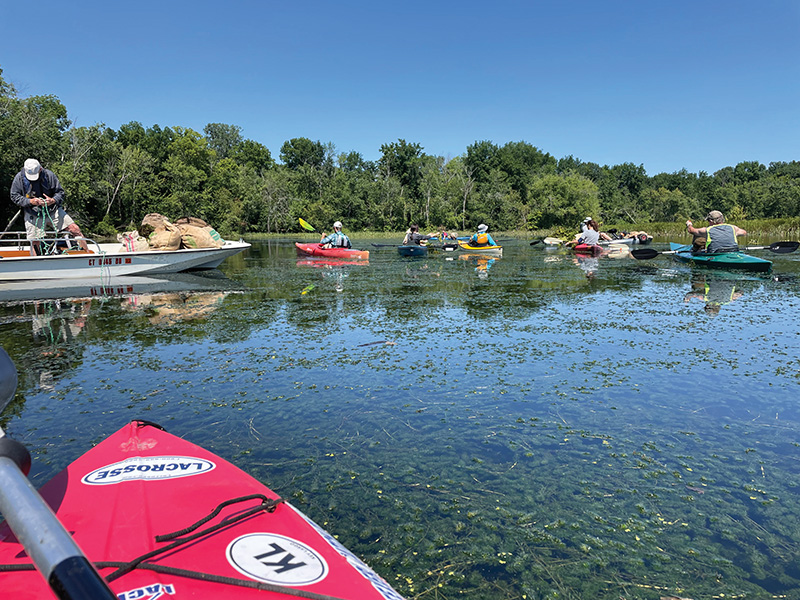
The presence of hydrilla hinders kayaking. Photo: Christy Kovel.
“The scale of demonstration efforts has been greatly diminished, limiting our ability to evaluate treatment effectiveness across diverse sites and conditions,” Foley says. “Second, reliance on carryover chemical stockpiles may restrict the consistency and comparability of treatment outcomes. Finally, with fewer demonstration sites, opportunities for stakeholder engagement, outreach, and data collection are reduced, ultimately slowing progress.”
“As expected,” Foley adds, “hydrilla rebounded this year, though hopefully at a lower density than before treatment.”
CRC’s Beerman agrees. “I’m worried that any stalling of the program will be harmful. When the flow of data is interrupted, we lose precious time.”
The hydrilla problem is on the front burner for at least one local elected official. Connecticut State Representative Renee LaMark Muir, who represents the river towns of Chester, Deep River, Essex, and Haddam, is working to make sure state funds remain.
“The US Army Corps of Engineers research into eradicating hydrilla has benefited the state, but the project has not received enough funding to meet the need,” LaMark Muir says. “It’s a shame, too, because it has caused reductions in the number of sites that needed treatment this year. I expect federal funding will be further reduced or eliminated in the next federal budget, so I’m working with my legislative colleagues to secure state funding to allow DEEP [Department of Energy and Environmental Protection] to join in the fight to eradicate hydrilla. We need to expand the number of sites treated, and to provide funding to municipalities that are already paying to treat ponds and lakes in their boundaries. I’d really like to see Connecticut preserve and protect the river and all waterways in which invasive species flourish.”
Folks who live along the river have seen how dramatically hydrilla is changing the landscape. Jane Cavanaugh has lived along Post Cove in Deep River for 24 years. “The change in the ecosystem in just the last five years has been dramatic,” she says. “We used to see great stands of native wild rice, which attracted enormous flocks of red-winged blackbirds. Now, when you look over the cove, it’s eerily quiet; a thick, muddy expanse of matted hydrilla where the wild rice used to be. The birds are all but gone. Without federal and state efforts, I’m worried about the long-term viability of this fragile ecosystem.”
As if hydrilla itself weren’t hard enough to manage, scientists and advocates have another rapidly spreading problem to contend with: conspiracy theories. Last summer, a former rapper and self-proclaimed conspiracy theorist opined that scientists and politicians were engaging in a coordinated effort to “poison the river.” The unfounded assertion had a brief moment, including a rally at the Connecticut State Capitol attended by about a dozen people, an online petition, and some argumentative folks who crashed a press conference and insisted on being heard but would not give their last names on the record. After some experts educated people about the years-long research process and the testing program, the movement fizzled out.
“We understand why people are uneasy,” Charamut says. “Using herbicides in water is a big deal and should only be used when absolutely necessary. That’s exactly why this project has been years in the making—studying what we’re dealing with, researching treatment options, and testing methods in discreet areas.”
Charamut says that while conspiracy theories are unfortunate, this one did call more attention to the problem. “This is a really tough environmental challenge,” she says. “It’s complex and cannot be reduced to sound bites. That’s why it’s extremely important to base decisions on science, not speculation; transparency, not secrecy; and accountability, not shortcuts. And above all, to keep a deep commitment to protecting both people and ecosystems.”
Some scientists express frustration that too many people are forming their opinions without first-hand knowledge. If one actually goes out onto the river, it’s easy—even for an amateur—to see the difference that CAES and USACE have already made. While experts warn of being too optimistic or overstating the success of the management efforts, there are signs that where hydrilla has been treated, the damaged ecosystem is reverting to a more balanced state.
“Within the same year of application, we observed many native aquatic plants not only persist in the system but, in some cases, expand,” says Foley. “For example, at Selden Cove, Elodea nuttallii [nuttall’s waterweed] was observed at much higher densities compared to pre-treatment conditions. Similar trends were noted at other sites as well, where we documented increases in the relative occurrence of coontail (Ceratophyllum demersum) and vallisneria (Vallisneria americana). Even small stands of native wild rice have been documented.”

Chapman Pond in 2021 before treatment and in September 2024 after selective hydrilla control. Photos: CAES.
“Throughout my career in invasive aquatic plant management, I have seen challenging situations evolve into effective and efficient management programs, and I believe the same can be achieved here,” Foley says. “I am genuinely excited to see where the research leads and what we can learn about this new strain of hydrilla.”
Foley, who is an entomologist by training, naturally thinks outside the box when it comes to pest management. “I have seen firsthand how insects can play a critical role in aquatic plant management,” he says. “Integrated pest management works best when we combine the strengths of multiple approaches rather than relying on a single solution. I find it encouraging that we already have biological control agents in the form of herbivorous flies in my lab, and we are actively studying their impact and feeding preferences on Connecticut River hydrilla. This gives me real optimism that, over time, we can build a sustainable and effective management strategy.”
Even as hydrilla spreads, so, too, does reason for hope. Rhea Drozdenko, CRC River Steward, says, “Awareness is definitely rising. Hydrilla has been around since 2015, and it’s taken a while, but now it’s almost a household word. Recreational boaters are generally paying attention to the vital ‘Clean, Drain, and Dry’ program to help curb the spread. And I was astonished recently when I did an educational unit with students in kindergarten through fifth grade at the MacDonough School in Middletown. They knew all about hydrilla! Maybe their parents talked to them and their teachers. But they knew, and that was terribly exciting. In this line of work, we see a lot of setbacks, so any glimmer of hope is worth hanging onto.”
To read more about Connecticut’s hydrilla program visit:
US Army Corps of Engineers at
https://www.nae.usace.army.mil/Missions/Projects-Topics/Connecticut-River-Hydrilla/
Connecticut Agricultural Experiment Station at
https://portal.ct.gov/caes/oais/connecticut-river-project