
 This article appears in the Winter 2025 issue

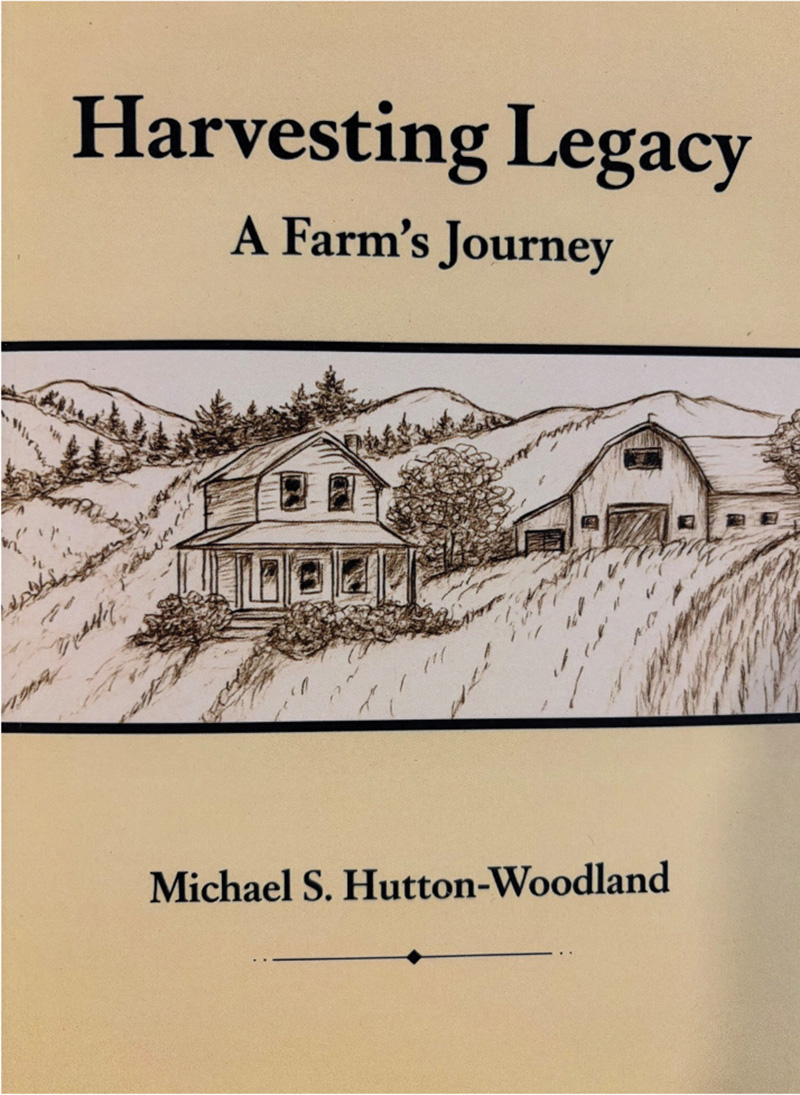
First-time novelist Michael Hutton-Woodland reached out to me about his new book, which chronicles the deliberations of an aging farmer faced with a choice between selling his farm to a developer or selling it to a conservation organization at a much lower price, but with the promise that the land would remain as farmland into perpetuity. The topic is an important issue in our watershed today that we have not covered, though we have celebrated farming in a number of stories.
Michael is a retired psychiatrist, so he knows a thing or two about complex relationships, complex situations, and people’s reactions and interactions. He is also a volunteer land steward with Kestrel Land Trust, so he knows a thing or two about land preservation. Put them all together in a novel of his great imagination and you can live through the thinking process of the farm owner as he takes his time before deciding upon a plan of action.
The story takes place along the Connecticut River near Hadley, Massachusetts, where the Hadley loam—the alluvial deposits from floods and even ancient geology and arguably the finest agricultural earth in the watershed—is good for virtually any crop, from tobacco and corn to “Hadley Grass” (a.k.a. asparagus).
Michael’s unique approach is to cast this story in the modern context of decreasing farming career opportunities and children with alternative lifestyles and ambitions or fears that are inclined to lead them away from a lifetime of farming. For those interested in taking the journey along with him, the title of his book is Harvesting Legacy, published by Combray House.
Second on my mind is the Norcross Wildlife Foundation in Wales, Massachusetts, which recently hosted the burn of a mishoon, that is, the fabrication of a canoe by burning out the center of a large log as was done in ancient times for Native American transport. The Nipmuc, who abounded in southern Massachusetts 400 and more years ago, like to say, “We’re still here.” In fact, there are enough members of the tribe with interests in their cultural heritage that they have set their sights on establishing a K–12 “immersive school.” Such a school would teach children their language and culture, as well as prepare students for life in the modern world.
Meanwhile, we recommend a visit to the Norcross Wildlife Foundation’s 8,000-acre conservation area, which features a variety of educational programs and two miles of trails for public hiking. We are thrilled that the Norcross Wildlife Foundation has joined us as a River Partner and appreciate their invitation to see the mishoon take shape and learn more about the Nipmuc (see our story on page 32).
Next on my mind, we have been so taken by the barred owl that in this issue we have our second story in a row about this curious and impressive bird. It has eyes that do not rotate in their sockets, but only when the head turns, which it can do over a range of 270 degrees, just 45 degrees from full circle. Its optical organs take up 70 percent of the space in the skull. In addition, this owl’s ears are located at different levels on its head, asymmetrically, giving it an ability to detect minuscule changes in the arrival of sound, and therefore direction, emanating from a mouse, say, beneath the snow. This capacity for triangulation, using both sound and sight, gives this bird an accuracy and precision in predation that enable it to survive at the expense of other competitors. In fact, in the state of California (where it is considered invasive), there is a bill pending to destroy some 450,000 barred owls in order to protect the native and lesser-endowed spotted owl. Could that possibly be the right answer? Read our story on page 29 to find out more.
In editorial news, we thank Bill Burt for his “One Photo” column over the past four years in which he shared his vast knowledge and extraordinary photography with us. We hope Bill accepts our invitation to contribute occasional pieces from his prodigious repertoire as the spirit moves him.
Finally, we are pleased to debut in this issue a new column, “Covering Ground,” by Christine Woodside, editor of Appalachia, the magazine of the Appalachian Mountain Club. We think you will enjoy taking virtual hikes along with the adventuresome Chris.


Dick Shriver
Publisher & Editor