
 This article appears in the Winter 2025 issue
Fire, Forest, & Water
Create a Traditional
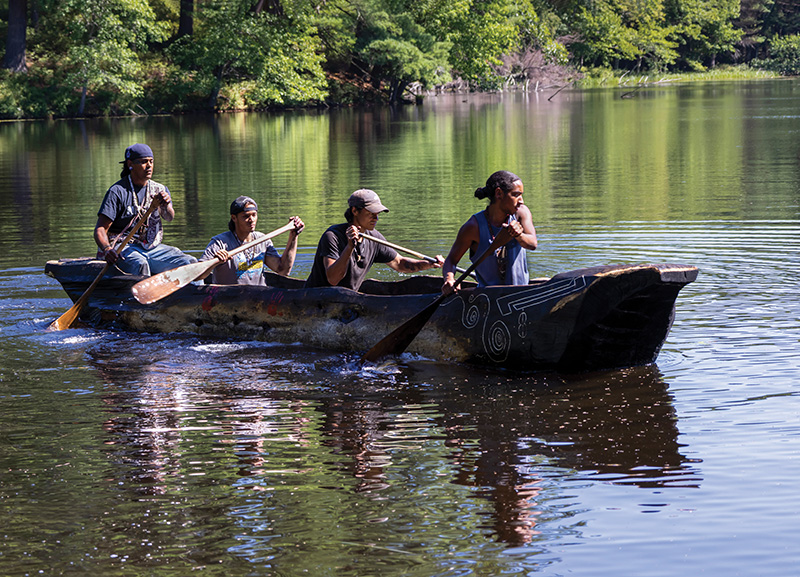
When Andre Strongbearheart Gaines-Roberson, Jr., came to the phone, he couldn’t help sounding a bit tired, having worked around the clock over the previous ten days, catching an hour or two of sleep in his tent at various times while supervising the “burn” of a mishoon, or canoe, hollowed out from a tree, in the Nipmuc tradition. This mishoon, built from a section of white pine 22 feet long and 42 inches in diameter, was one of the largest he had ever created.
The burn took place at the Norcross Wildlife Foundation’s property in Wales, Massachusetts, with a tree donated from its land. When the burn was completed, the mishoon was launched with six people in it to paddle; Andre said it could easily hold ten. For its large size, he was pleased with how well it was balanced, the result of his team’s careful burning and scraping out the charred insides of the craft, while spraying cold water on the outside to keep the wood from drying out and cracking. To maintain the fire continuously, Andre and his team burned several cords of firewood. The mishoon will be used for visits to sister communities up and down the Connecticut River and other waters as was the custom in ancient times.
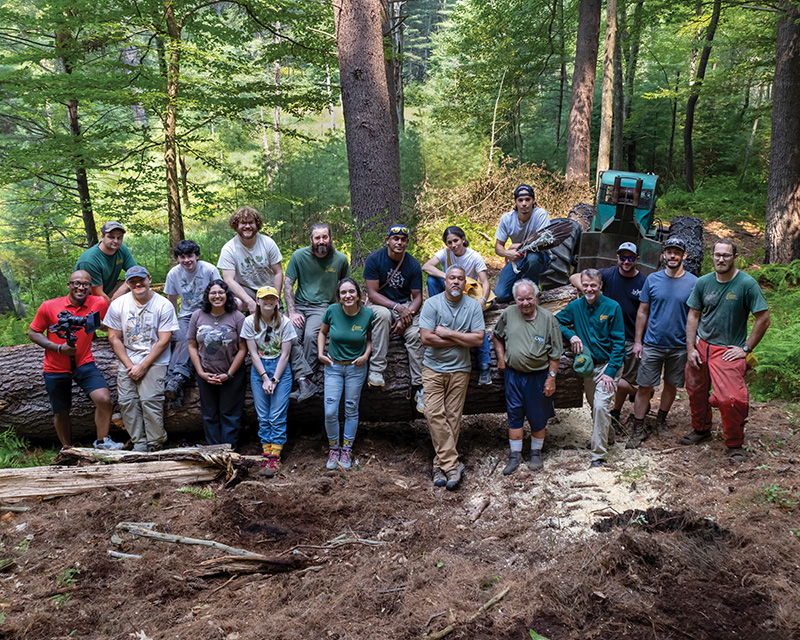
The team of Nipmuc Tribe and Norcross Wildlife Foundation engaged in the mishoon burn.
Andre, a member of the Hassanamisco Nipmuc Band that has inhabited the midsection of the Connecticut River watershed, mostly in south-central Massachusetts, for thousands of years, was recently appointed Historic Preservation Officer for his tribe. In this capacity, he is responsible for ancestral artifacts, land stewardship, and cultural practices. There is no book to tell him what to do. He devoted the past 18 years to learning—including how to make a mishoon—mainly by listening to his father and his elders and by actually doing things, thereby implementing and carrying on the traditions of his ancestors.
In addition to working with his own tribe, Andre assists other tribes all over the country in their own preservation efforts. After the mishoon burn, he left for a few weeks to assist the Lumbee Tribe in southeastern North Carolina (with 55,000 members, the Lumbee are the largest Native tribe east of the Mississippi today).
Nipmuc translates into freshwater people. With tens of thousands of members in the early 1600s, the Nipmuc were perhaps the most populous tribe in the Connecticut River watershed. Wars with the colonists, especially King Phillip’s War in the 1670s during which the New England tribes led by Metacomet (also known as King Phillip) tried to drive the colonists out, severely reduced the Nipmuc people.
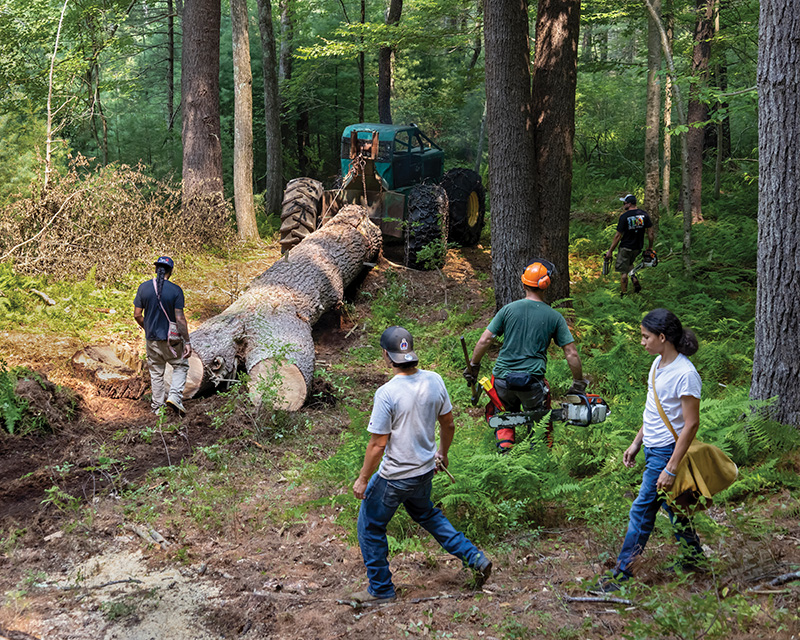
The felled tree being hauled into position for the burn.
Following a sordid history of interactions with colonists, not to mention imported diseases, today the Hassanamisco Nipmuc Band claims 1,600 members. In 1980 the tribe applied for federal recognition in collaboration with the Chaubunagungamaug Band; in 2004 the application was denied after the Bureau of Indian Affairs (US Department of the Interior) determined they failed to meet several criteria for such recognition. The Hassanamisco Nipmuc Band has been a state-recognized tribe in Massachusetts since 1976.
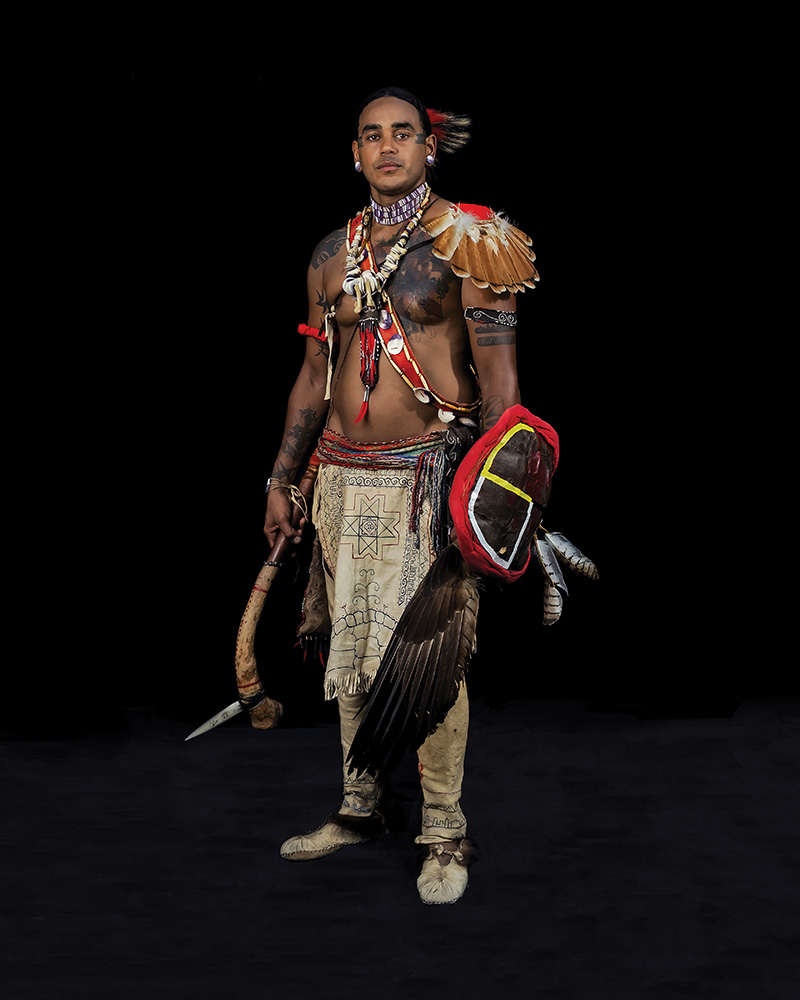
Andre Strongbearheart Gaines-Roberson, Jr., Historic Preservation Officer, Hassanamisco Nipmuc Band.
To say that Andre is a role model for his fellow Nipmuc is an understatement. Others observe what he does. They listen to him. They follow and learn from him. He teaches by example. He teaches that the water and the trees are not commodities to be exploited. They are relatives, cousins, to be cared for. In return, the forests and waters will care for us. This is a common belief among other Native American tribes, a belief not readily comprehended by non-Native Americans. With a little mental stretch, however, it can become eminently comprehensible. According to Andre, “If the earth and water are unhealthy, then we the people are unhealthy.”
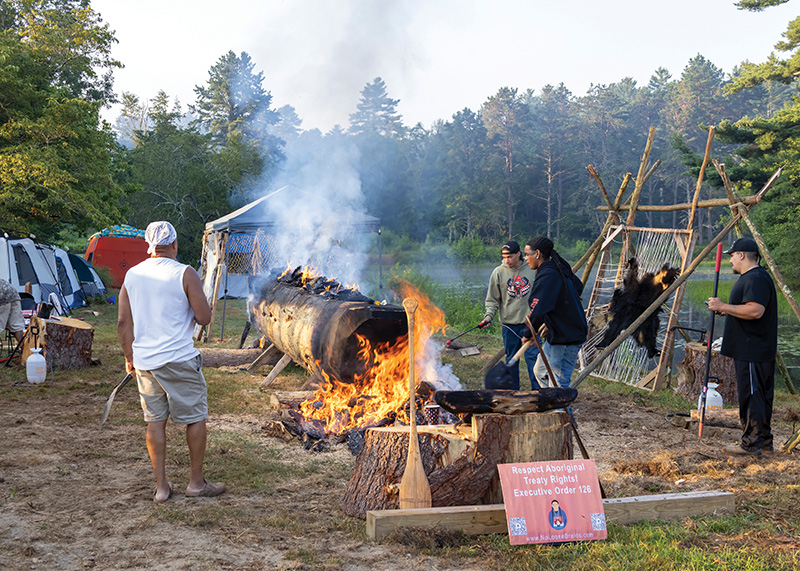
Burning out the hollow of the canoe—staffed by the team round the clock for 10 days.
Andre works through a nonprofit he founded called No Loose Braids. The name is a metaphor for connecting and strengthening community bonds rather than letting those bonds hang loose and unravel. The name stands for everything that Andre and his organization work for every day, whether it’s cultural revitalization, improving reciprocal relationships with sister tribes and the earth, or stewardship of the land. They are especially attentive to how the land is used to produce food, or to contribute materials for construction of homes.
The forested land of the Norcross Wildlife Foundation, which donated the large white pine for the mishoon, is another sight worth seeing. Two miles of trails across its 8,000 acres afford access to incredible and beautiful nature, open for public use.
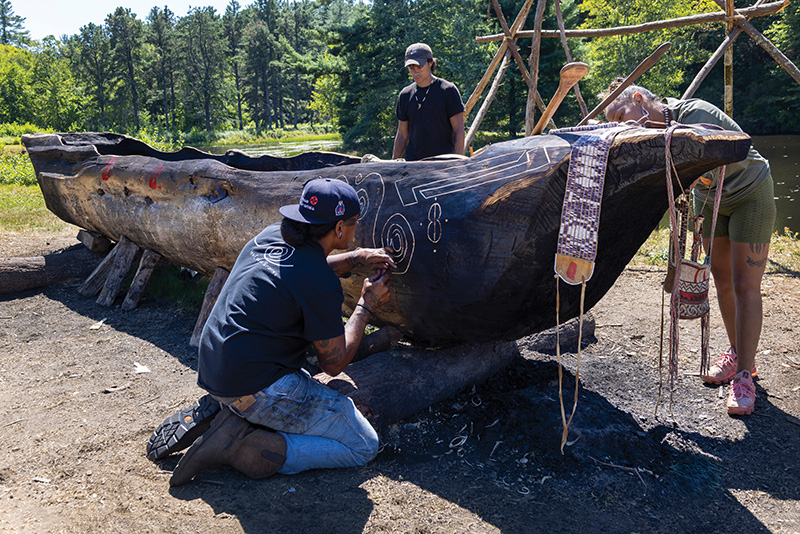
Christening and naming the mishoon.
The Norcross approach to sustainable conservation is also worth noting. Arthur Norcross set out to conserve the natural surroundings and wildlife he had grown up with in nearby Monson. He and his sister founded the Norcross Greeting Card Company in the 1920s, the success of which enabled him to establish the Norcross Wildlife Foundation in 1964 shortly before his death in 1968. Today, as stated on its website, that foundation is engaged in “preserving natural lands that support native plants and animals and a robust and resilient regional ecosystem. The foundation stewards this land for the public benefit through clean air and water, storm water control, and temperature regulation that natural land provides to the region, through biodiversity conservation, and through public and educational programs for all communities of the region.”
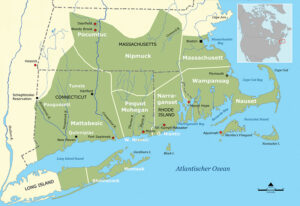
Tribal territories of Southern New England tribes about 1600. Source: Wikimedia Commons.
The foundation is somewhat unique for environmental nonprofits in that its endowment left by Mr. Norcross provides for the perpetual management and care of the property. While the foundation accepts gifts and contributions, it also supports important causes through its own grants program.
When speaking about the Norcross Wildlife Foundation’s relationship with the Nipmuc and what might be learned from their long history of successful stewardship of the land, Ed Hood, Executive Director of the foundation, cited as an example the Nipmuc approach to managing stands of white cedar. A uniquely valuable and increasingly rare tree, the Atlantic white cedar was overharvested for construction because, among other reasons, of its resistance to rot. The Nipmuc, having recognized the value of white cedar swamps long ago, employed for eons a concept of “honorable harvests” or, as we might say today, sustainable harvest management for the long term.
For much of its history, the foundation was “not science-oriented,” according to Ed, “but that is changing.” Scientists are now on the foundation board, for example, and their staff includes experts like Dan Wilder, Director of Applied Ecology, and Caroline Aguadelo, a newly-minted PhD from UMass specializing in “invertebrates,” those generally small-to-tiny animals and insects lacking a backbone that comprise 95 percent of all known animal species including spiders, butterflies, crabs, and snails. This reflects the foundation’s strong belief in the importance of invertebrates and their role in improving biological diversity, a prime strategy of the Norcross Wildlife Foundation.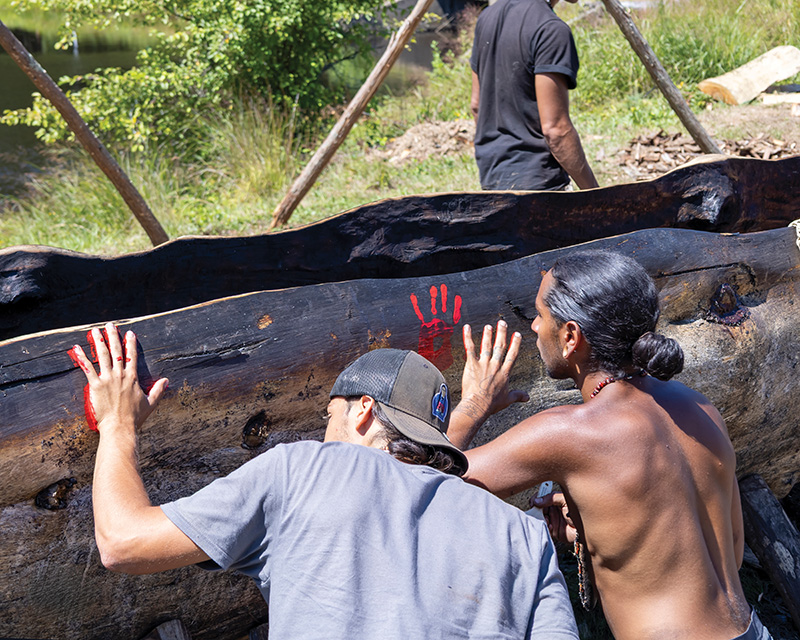
Ed believes the foundation should provide leadership in building resiliency and sustainability into landscapes to “withstand the challenges of today,” and the best way to achieve resiliency is to “build diversity into your landscape.” It can take a long time, much more than a single season, to prove what works and what doesn’t. To compensate, Wilder believes in great redundancy. “I’ll plant 50 species expecting that 25 will work.”
When asked to compare the work of a private foundation like Norcross to the work of federal and state agencies, Ed believes the foundation benefits significantly by having greater decision-making flexibility and the ability to move more quickly. He concurs that the Norcross Wildlife Foundation is, unintentionally, a “well-kept secret,” a situation he plans to change. The foundation headquarters building has rooms and equipment with which they offer a variety of educational programs. Ed referred to the 2025 Summer Program Series for young people which, again from their website, “featured activities like Wildlife Wonders (ages 3–7), Forest to Fabric (ages 5–14), and Nocturnal Nature Adventure (ages 5+). Other offerings include the Trailblazers Program (ages 5–12) and Tiny Trekkers (ages 3–5), as well as an Internship Program for young adults interested in conservation.”
Ed called the mishoon burn “historic.” Such collaboration is part of a wider effort by the Norcross Wildlife Foundation to preserve natural lands, protect native habitat and offer public programs to a diverse community including local tribes such as the Nipmuc.
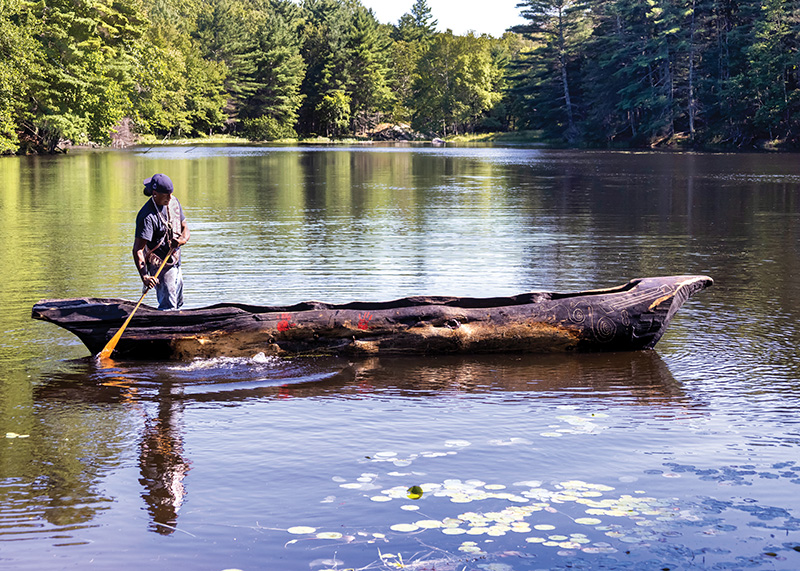
Savoring the moment of a job well done.
Resources
No Loose Braids
www.noloosebraids.com
Hassanamisco Nipmuc Band
nipmuc.gov
Norcross Wildlife Foundation
norcrosswildlife.org
Dick Shriver is publisher of Estuary magazine and a frequent contributor. The Norcross Wildlife Foundation is Estuary’s newest River Partner. Read their announcement in “Let’s Go.”
Photographs are by Scott Foster. Scott Strong Hawk Foster is a Black-Native American photographer whose proud roots include Hassanamisco Nipmuc, Mohegan, and Cherokee lineage. Scott is a graduate of Florida State University.