
 This article appears in the Winter 2025 issue

William Earle William’s ethereal photographs transport us back in time and to another place—familiar, and yet layered with new meaning.
Through a two-year residency with the Florence Griswold Museum in Old Lyme, Connecticut, culminating in a special exhibition there last year, and now a catalog, Their Kindred Earth, Williams explored the eastern side of the Connecticut River estuary. He searched shoreline and village—places we pass daily with nary a look over our shoulder—for sites of freedom and enslavement. As Florence Griswold Museum curator Jenny Parsons asks in her essay in Their Kindred Earth, “What do we know about the land we live on?”
Old Lyme was settled as part of the Saybrook Colony in 1636 and split off as part of Lyme in 1665. Carolyn Wakeman, the museum’s archivist, uncovered the first documented enslaved African in Lyme/Old Lyme, c. 1670.
The history of slavery is not confined to the estuary, however. Slavery extended up the Connecticut River to Hartford, Springfield, and beyond, including the river towns in between. Africans and African Americans were enslaved by merchants and ministers, blacksmiths and widows. From the beginning, enslaved people sought freedom by any and all means. Abolishing slavery in the watershed worked its way from north to south: Vermont first (in 1777) and Connecticut last (in 1848).
William’s project is to uncover, as he notes in the catalog, “the roles that people of color played in American history. It’s important to tell all sides of the story.” In his photographs Williams uncovers what has been buried and forgotten, and asks us to consider: who lived here? Who passed this way, perhaps on their way to freedom?
These three images were selected from more than 125 included in the catalog. The extended captions, which reveal both the history of the place and what Williams was thinking about as he took the image, were written by Parsons, Wakeman, and Amy Kurt Lansing, in consultation with Williams, and are reproduced here with permission.
Williams received his MFA from Yale School of Art. Yale was recommended to him by his mentor, the renowned photographer Walker Evans who owned a home in Lyme. Williams is the Audrey A. and John L. Dusseau Professor in the Humanities, Professor of Fine Arts, and Curator of Photography at Haverford College.
Elizabeth Normen is managing editor of Estuary magazine and a historian working on a book, Awakenings and Revolutions: The Harts, Saybrook, and the New Nation (expected 2026). The FloGris is a River Partner of Estuary magazine.
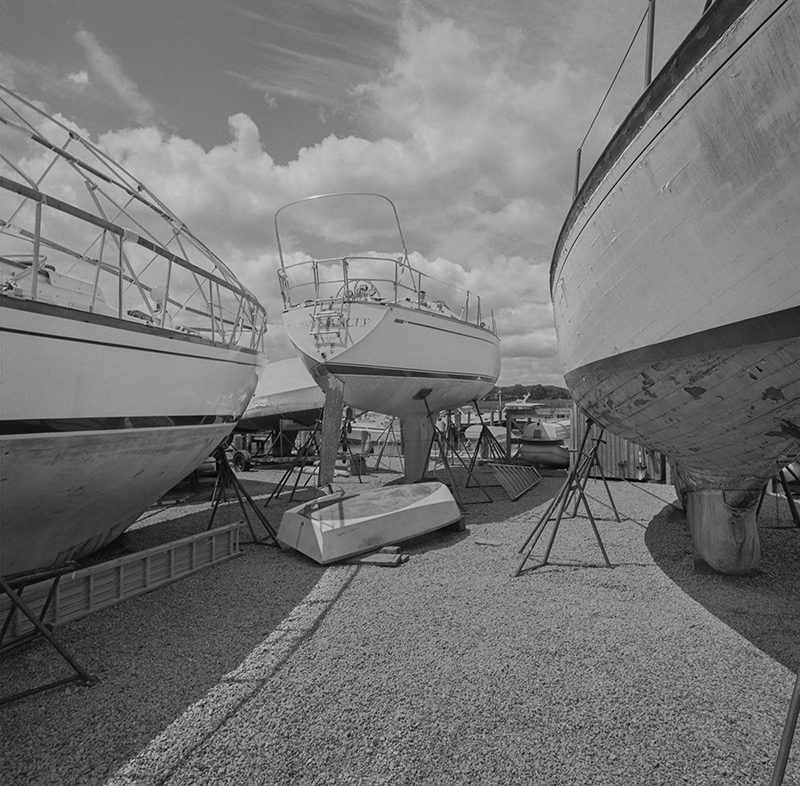
William Earle Williams, Old Lyme Marina, Old Lyme, Connecticut, 2023. Silver gelatin print, 7½ x 7½ in. Courtesy of the artist.
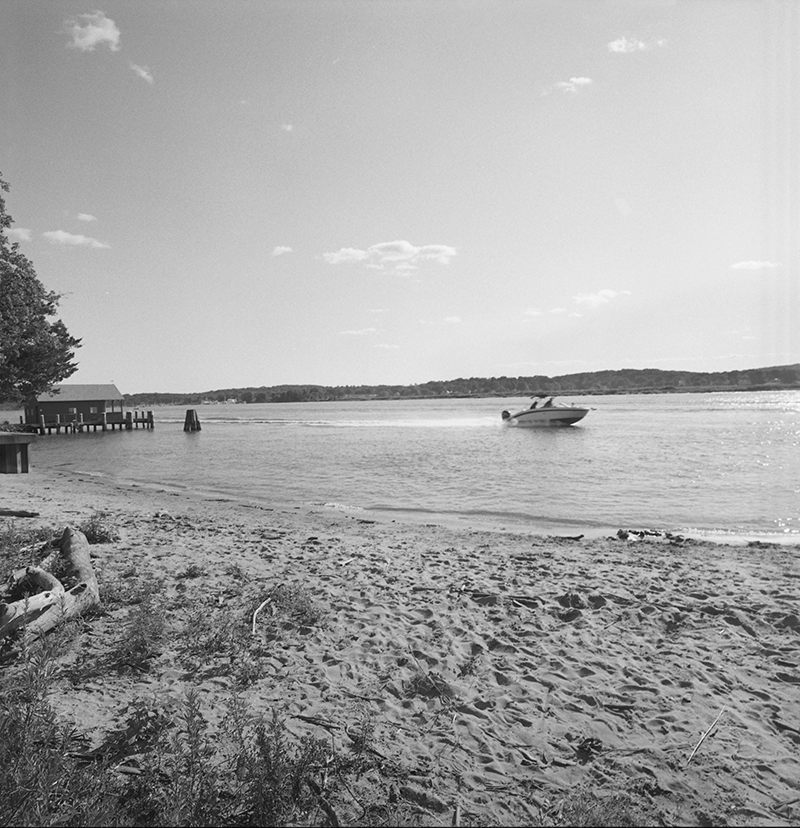
William Earle Williams, Beach at Ely’s Ferry Road, Connecticut River, Old Lyme, Connecticut, 2023. Silver gelatin print, 7½ x 7½ in. Courtesy of the artist.
Along the banks of the Connecticut River, Williams noted manicured lawns and sites of recreation and leisure. He contemplated the ways in which this was a very different place 250 years ago. Not far from this beach is the site where Moses, the first documented enslaved person in Lyme, labored on Richard Ely’s Six Mile Island Farm before 1670.
Ely’s descendants built three houses on today’s Ely’s Ferry Road where Warwick, Cesar, Tonney, Peter Freeman, and others were enslaved. Warwick was 46 in 1769 when Mary Noyes Ely specified in her will that “my Negro man Named Warrick Should be free after my Decease […] to be his own man.” She left Warwick some farm animals with which to begin his life anew.
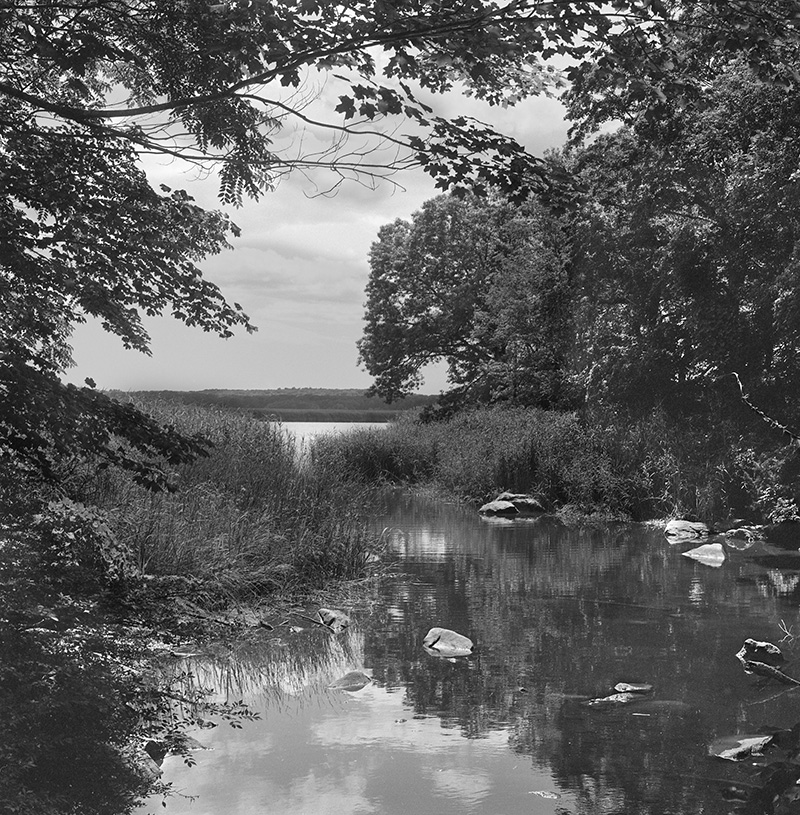
William Earle Williams, Tantummaheag Brook, Old Lyme, Connecticut, 2023. Silver gelatin print, 7½ x 7½ in. Courtesy of the artist.
Their Kindred Earth: Photographs by William Earle Williams
Edited by Jennifer Stettler Parsons, PhD, with contributions by Frank Mitchell, Carolyn Wakeman, William Earle Williams, and Deborah Willis
Wesleyan University Press, $39.95
Available at https://florencegriswoldmuseum.org/shop/