
 This article appears in the Winter 2025 issue

Welcome Christine Woodside and her new column, Covering Ground. She is the author of three books, including a wilderness memoir Going Over the Mountain, and the longtime editor of Appalachia journal. She writes from a tiny office in downtown Chester, Connecticut, and lives in Deep River.
For years my favorite road walk has been an out-and-back route from home in Deep River, Connecticut, to the end of Straits Road in Chester. I turn around after visiting a waterfall where the south branch of Pattaconk Brook flows over a dam. The dam is small and unassuming, but I am fond of it because it is so ordinary. I’m usually the only one stopping here. I can visit early before work and feel as if I stepped into another world briefly, surrounded by the sound of rushing water.
I often stop on the grass and peer down at the spillway, which stands roughly level with the road and drops eight feet, funneling the river underneath the road through a double box culvert into the natural rocky riverbed. Sometimes I cross the road to the small-town park, below the dam, and watch the Pattaconk rush over the rocks. A short distance downstream, the river passes into the larger Jennings Pond, also held back by a dam.
I have watched the water descend here in dry and wet seasons, in flash floods and midsummer droughts—raging, pouring, sliding, trickling. Once, after a big storm on September 26, 2018, tannin-tinted storm runoff raged like a mound over that spillway and tumbled crazily under the road and downstream, drowning out my amazed yells. Five years ago, I began noticing cracks and a crumbled section in the “wingwall,” or retaining wall, below the dam. That summer, I spotted a beaver dam and lodge in the pond; I didn’t see the beavers, but I didn’t care.
Sometime the following year I noticed that part of the wingwall was reinforced by riprap (small rocks) encased in wire netting, stabilizing it. (These are not technical observations so much as emotional ones.) In 2022 I spotted a repair to the concrete on that wall. A few months later, on an August morning after weeks of dry weather, I meditated on a trickle of water seeping over the spillway, unable to budge debris stuck below.
Last November, a tree service removed a stand of trees from the opposite bank to meet state requirements. At first, I thought the landscape looked sad and barren with the trees gone. But I now understand tree roots can interfere disastrously with a dam.
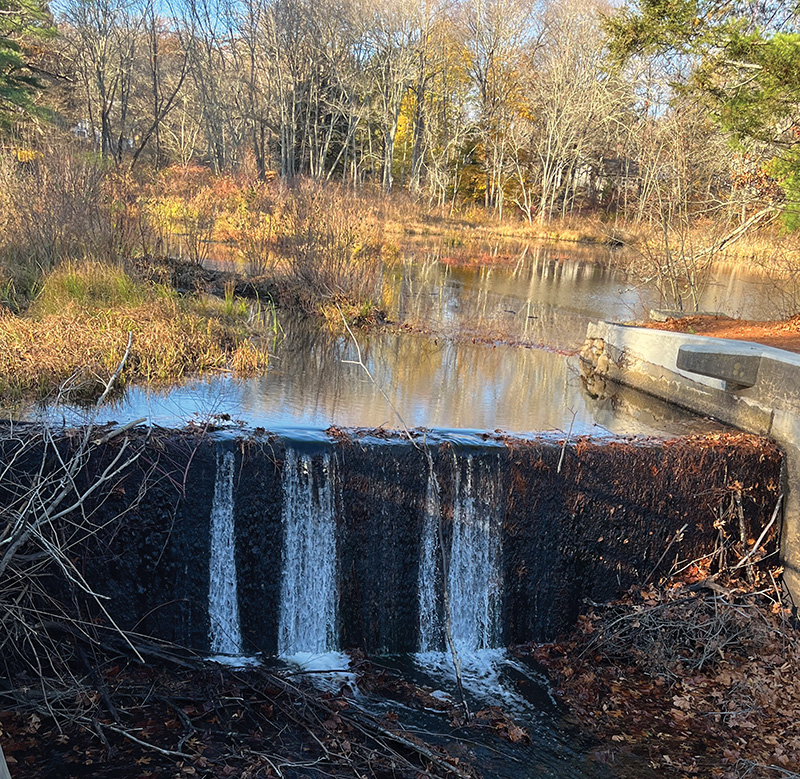
The south branch of Pattaconk Brook flows over a former mill dam in Chester, CT.
The town of Chester has owned this dam for many years. All the work to maintain it made me think more about what a dam is, what a responsibility it is to keep a dam safe. Watching the repairs the town has done with the help of state funds, I’ve admitted that I had been ignoring something I already knew anyway: that dams tell long and involved stories and change the habitats of the waterways they slow down. Yet it’s too easy to see them as a pretty backdrop to my life, like a Currier and Ives painting. Although, as I’ve said, I do love this little dam.
So I have taken myself on a journey of learning about what forces dammed this part of the Pattaconk River: industry, whose ghosts still hover here in memory. Upper Pond Dam is one of 13 mill pond dams that used to power factories along the Pattaconk. Another 14 dams still stand in Chester, along other brooks. This one was probably built of earth with—also probably—a rock face in 1790, Nathan L. Jacobson writes in an engrossing book on Chester’s dams. (Today, the visible part of it is concrete.) The moving river turned a water wheel that ran a small iron forge.
Sixteen years later, Arthur Snow and Joshua Smith bought the forge to make ship anchors, using local iron from swamps along Pond Meadow in Westbrook and marshes in Long Island Sound, according to a fascinating interactive map at the Chester Historical Society. Many factories used this dam until Stanley Works, the last private owner, moved to New Britain and gave the dam to the town.
Starting in 1830 the dam provided energy to manufacture augers, those metal objects that resemble giant drill bits and which bore holes into wood, often for shipbuilding. Ezra and Joshua L’Hommedieu moved here from another site downstream. Ezra had earlier obtained a patent from the federal government to build his “single twist” augers. (A sign commemorates the brothers below the dam, and the town park there is named for him.) Those augers were apparently better and simpler than most, moving through wood in a way that let the chips “pass up more freely and are not crowded together as in the common twist and pod augers,” Ezra wrote in his US patent application. The Navy bought 8,000 of these in a single year. In 1881 Russell Jennings Manufacturing Company bought the factory here and used it for about a decade. Then that company joined its auger and auger bit manufacturing in a large building near Jennings Pond just downstream. Jennings dominated the world market in auger bits.
Next came a company that made wooden treenails, which were peg-like things used in shipbuilding. Soon this company, Middlesex Manufacturing, turned to making baseball bats and handles. By the mid-1920s it was making handles with hickory shipped in by train from the South. That plant closed in 1945. The factory buildings were torn down, and the site below the dam stood vacant until 1973, when the town landscaped it into L’Hommedieu Park.
What remains is the dam. The state of Connecticut rates Upper Pond Dam class BB: “a moderate hazard potential dam” which, if it failed, could damage Straits Road and lead to “mild economic loss.” The flood of June 1982 did wash out Straits Road. (I wish I could have seen that firsthand.) Today, two houses stand on the pond above the dam, and below the spillway, on the other side of Straits Road, the river runs past the park and woods.
“My” dam is one of at least 4,400 human-made structures in rivers and brooks in the state. Many of them are as old as this one, and most of them are privately owned. “Dams and dikes cannot be thought of as a part of the natural landscape, but rather as artificial structures which require ongoing inspection and maintenance,” the state’s dam regulation website notes. Dams look aesthetic when the water flows over in curtains, but they are industrial objects. They mark ingenuity as they interfere with rivers. A mill pond supports water birds, but the birds would thrive better with a moving waterway, noted Rhea Drozdenko, the Connecticut River Conservancy river steward in Connecticut. “It is part of a healthy ecosystem to have a free-flowing river,” she told me.
Few dams serve their original purpose of making power. In the past century, more than 2,000 dams across the United States have been removed—two dozen of which are in Connecticut. But this dam is not slated for removal any time soon. It’s located upstream from other dams, so taking it out would not clear routes for fish to swim upstream unless the downstream dams also were taken out. Then: removing a dam is as difficult as building it, requiring permits and detailed plans on the effect of the waterways being freed through developed areas. It takes time and significant money.
The Connecticut River Conservancy works with environmental partners to evaluate where it would make sense to remove a dam. Is it feasible to remove? Is it safe? “We have not discussed that,” said Chester First Selectwoman Cynthia Lignar. The town’s work with the grant money it received has focused on making the dam and this part of Straits Road safe, which includes fixes to the dam itself and also monitoring the vegetation that grows in and around the pond. Dams “are a significant part of our history,” Lignar added. Whether to ever remove the dams could be a question for the future, she said. “Not during my administration.”
In a broader sense, just standing by the fence near the Upper Pond spillway lets me put my attention to the watershed that drains this area and joins the Connecticut River and Long Island Sound. The rushing water at the end of Straits Road has never lost its hold on me. I have meditated on how brooks and the rivers they join are always changing, never the same. Falling water, whether a giant power plant near Niagara Falls or a little mill pond in Connecticut, just mesmerizes me.
But the more I sink into the history and structure of my favorite dam, the more clearly I see that if I’m going to value this landscape, I must understand how people have molded it.