
 This article appears in the Winter 2025 issue
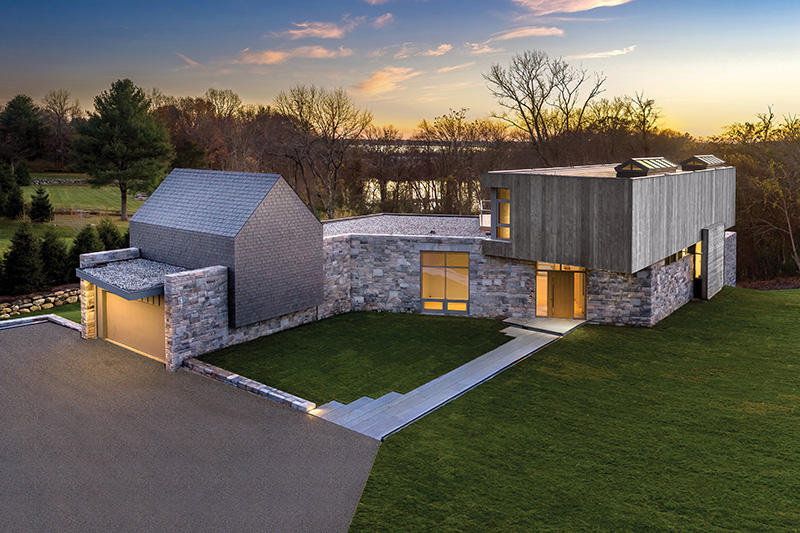
Greystone as seen from the street side with the Connecticut River in the distance. Photo: Dennis Carbo.
On a steep hill above the Connecticut River, Greystone shines in the morning sun. The texture of the natural stone contrasts with the clean modernist lines of wood and glass. From the street, the house looks small and sheltered by enigmatic walls. From the river side, the house reveals itself as expansive and open, three full stories of windows and views. Inside, swathes of warm wood nestle you comfortably as you gaze through glass walls and windows across the estuary toward Ragged Rock Creek. Meanwhile, deep in the hillside, geothermal heat circulates into the house, efficiently and gently thawing the frosty New England winters.
This is the work of Chris Arelt of Nautilus Architects, recent winner of “Best of Houzz” award for Design and Customer Service on Houzz, the leading online platform for home remodeling and design. It was chosen by a vote of millions of homeowners from among three million industry professionals. “It’s exciting to be recognized as a leader in sustainable, efficient, and innovative home design,” says Arelt.
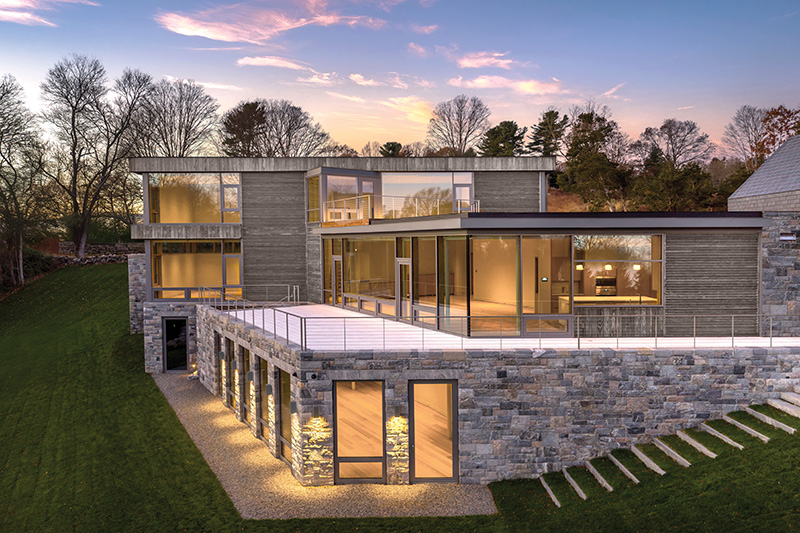
From the river side, Greystone takes advantage of the site’s slope down to the river. Photo: Dennis Carbo.
“Architecture is like solving a puzzle,” Arelt continues. “You find the siting you want, the configuration that makes sense for light and views, and then fit in all the pieces, pushing things around until you get it just right.” This search for proportionality and scale led him to name his firm “Nautilus,” a symbol of a naturally occurring golden mean, often used in architecture to create aesthetically pleasing proportions.
Originally from Stony Brook, New York, Arelt earned his Master of Architecture from Yale University in 1993. Influenced by the mill ponds and stone bridges of his native Long Island, he focuses on context in all his designs. “I used to ask my parents to drive me up and down neighborhood streets to look at the different house designs,” he says. “Stony Brook was a special place to be as a young boy—part of Ward Melville’s Three Villages—and now I can see how much of my childhood led me to my professional life.”
As a young architect, Arelt rehabilitated a parking garage and worked on corporate campus projects. But he decided that his real love was designing and building houses for people to live in. “It’s very important to me to contribute to the community,” he says. “I feel like architecture in its highest form should elevate people the way other art forms do, whether you’re looking at it and particularly if you’re inhabiting it.”
Greystone is one of his most recent projects and reveals a New England Modernist aesthetic. But as Arelt is quick to point out, the context is everything. “After I talk with a client and know the topography and surrounding built environment, the ideas germinate,” he says. “Greystone was an extreme case where the road is almost completely mute, so the front of the house facing the river includes plenty of glass.”
Nautilus begins each project as a blank slate, focusing on the “unique character of each client and site.” Arelt emphasizes to his clients the importance of orienting the house on the site properly. “That’s the single most important aspect of the design that’s going to make it a success,” he says. “Houses should look like they couldn’t be anywhere else.” Considerations like angle, elevation, and distance from the edge of the river are all key.
Some of the resulting houses are glass and steel contemporary, some are naturally lighted classic, but in all cases, sustainability is a key. That includes fitting the home exactly to the client’s needs rather than overbuilding, with each aspect thoughtfully and purposefully designed. This is often called “right-sizing,” which balances functionality, cost-effectiveness, and resource efficiency by creating multifunctional spaces, prioritizing quality rather than quantity, and reducing the demand for resources. After all, a massive, sprawling home increases heating, cooling, and maintenance costs and usually does not lead to greater happiness.
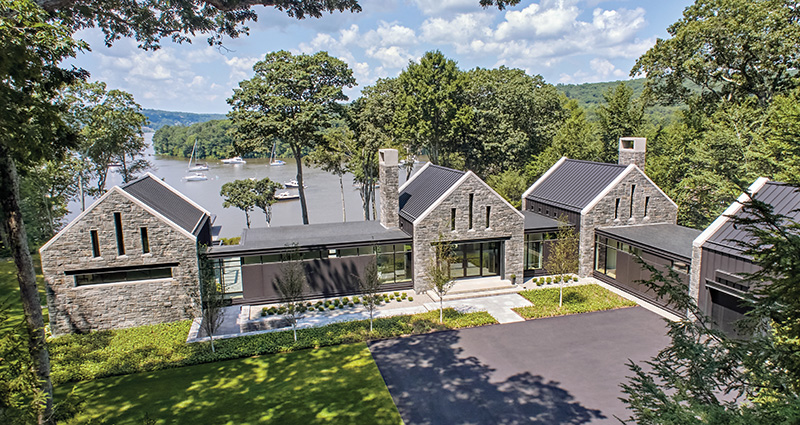
The Hamburg Cove home reflects elements of barns and churches. Photo: Robert Benson.
Two other houses by Nautilus further illustrate the design process. For a house at Hamburg Cove in Lyme built in 2017, the clients had a list of functional requirements but left the design largely up to Arelt. “It’s inspirational, because it liberates you,” he says. He figured out the most important aspects of the site, and designed a granite and steel masterpiece, with elements of barns and churches, all in achromatic white and gray and black. From the sunset-facing windows and infinity-edge pool, the homeowners now watch ospreys catch their evening meals or boats sailing into the small harbor. In 2024, the house won the prestigious Innovation in Design Award for Architecture sponsored by Connecticut Cottages & Gardens magazine.
On an eight-acre waterfront site at Riverbend, the owners wanted something completely different. They felt that their house should look like it belonged on the river, “comfortable, unpretentious, appearing as if it may have been around awhile and taking full advantage of the views without looking modern and glassy,” Arelt recalls. This resulted in a completely different look, a nearly classic-looking house with wide boards that resemble the clapboard houses of past centuries. The white and green colors, river stones, and granite sills give the impression of an older, perhaps wiser New England that valued permanence and modesty. The architects of centuries past may not have used the word “sustainability,” but that is exactly what they meant.
Achieving approvals for these building projects in the lower Connecticut valley requires finesse. Hurdles include the DEEP (Department of Energy and Environmental Protection), various zoning and wetlands commissions, and the Gateway Commission, which aims to preserve the character of the area. The Gateway Commission serves as an advisory board to towns like Essex and Old Lyme, which are not obliged to take that advice. But their comments are taken seriously, particularly when it comes to clear-cutting trees and light pollution. The houses Nautilus builds are often larger than they appear from the road and so require not only a cohesive and harmonious aesthetic, but also environmental considerations. That requires conscious choices and adaptation, not just to client needs, but to the landscape itself. “You have to stay true to your principles,” says Arelt. “But be open to new solutions to new challenges. Sustainability is absolutely key to long-term success.”
To do this, Nautilus is helping to bring the Passive House movement to the United States. Launched in Central Europe 25 years ago, passive homes include many things you might expect: exterior insulation, air-tight construction, high efficiency windows, and well-organized, whole-house ventilation systems. It can also mean other sustainable practices like using reclaimed existing materials and insulated concrete forms. The goal is net-zero architecture, meaning buildings with no net impact on the environment and that produce as much energy as they consume. To do this in these Connecticut River valley homes, Nautilus often integrates renewable energy like solar or geothermal with smart building technologies. Geothermal’s popularity is relatively new, but its efficiency and low environmental impact predict its growing importance in the future.
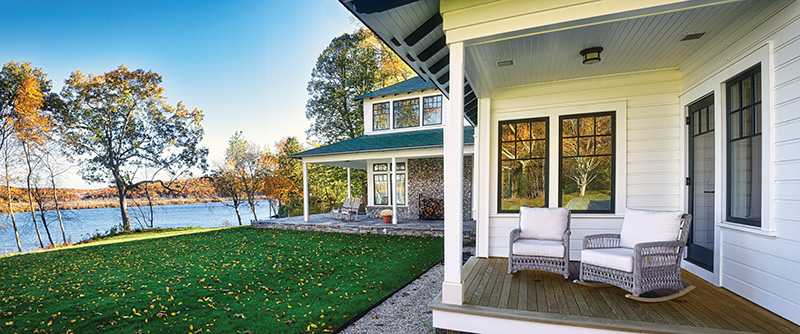
Riverbend resembles the clapboard houses of past centuries. Photo: Bill Crofton.
“A geothermal system is replacing gas or oil as the fuel for those, drawing energy from the ground or the water with wells and heat exchangers,” says Arelt. “You need anywhere from two to seven wells, which bring up heat energy from the ground and transfer it to a distribution system. That could just be a boiler or radiant tubes or a conventional hot air system.” Right now, these systems cost 30 percent more than a conventional system, but there are tax credits and, in the long run, efficiency will pay for the difference.
Both Greystone and the house at Hamburg Cove utilize this geothermal technology. But what unites all these homes is the river itself, a vital part of the dynamic nature of the Nautilus design approach. “I have the gift of a unique context here in the lower river valley,” says Arelt. “Our office is here on the Lieutenant River, right downstream from the Florence Griswold Museum, the birthplace of American Impressionism. They found the special quality of light here. So, maybe what they found here is fueling me in the same way.”
Eric Lehman is the award-winning author of 22 books, including New England Nature, New England at 400, the Quotable New Englander, and A History of Connecticut Food.