
 This article appears in the Winter 2025 issue

The Spotted Turtle
A Cryptic Brumater & Estivater
By Andrew Fisk
Winter has come around again with cold, wind, ice, and snow. While I appreciate winter and am warm in my home, this time of year makes me recall warmer weather, swimming in a river, and soaking up the sun. I wonder if our animal or fish brethren think the same while they, too, are hunkered down in their winter homes?
The spotted turtle is spending the winter in our wetlands and streams tucked under a meandering riverbank or in a wetland submerged under woody debris. Many aquatic turtles like the spotted turtle spend the winter under these conditions because they are able to reduce their metabolism and physiology through what scientists call brumation. (We, on the other hand, have to turn up the furnace or stoke the woodstove.)
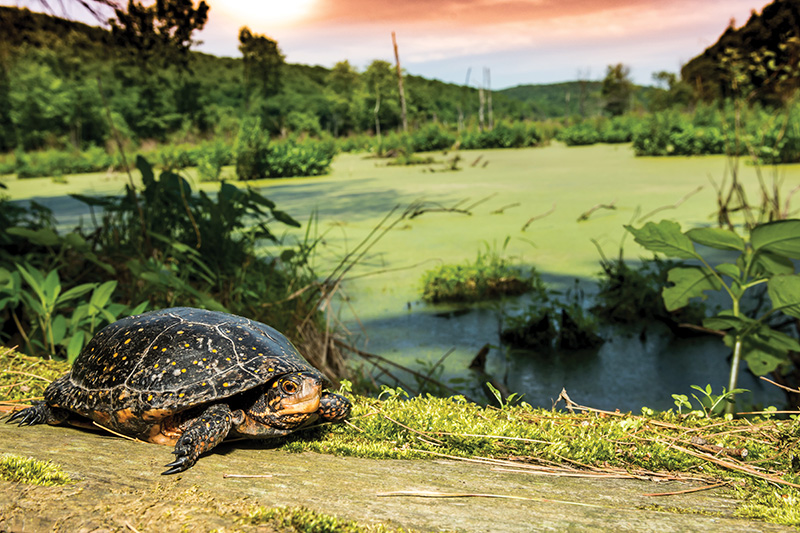
Spotted turtle. Photo: Getty Images/JasonOndreicka.
While I am impressed with this evolutionary strategy of brumation, I’m not really keen to try and acclimate myself to cold winter water even for a short dip. I do however, offer props to the spotted turtle’s other life history traits. If you are a paddler or walker around wetlands and slower moving rivers and streams, in spring you’ve certainly seen turtles hanging out on a log or rock basking in the sun. Basking is not just about warming up, but can also be a way to dry off and reduce algae growth on their shell. The sunlight also provides vitamin D. As often as not, you’ve seen them startle and hurry back into the water. I appreciate a good bit of basking time myself and can appreciate it not being interrupted.
But basking is not the only way a spotted turtle, or some of the other semi-aquatic turtle species, spends the warmer days. At the height of summer, as spotted turtles are hunting for worms and insects in upland areas around streams and wetlands, they are careful to avoid drying out. In our changing climate with its hotter and drier summers, this is an increasingly pressing challenge. The spotted turtle can again slow down its metabolism and become dormant through estivation. An estivating turtle will find a moist and shady spot to ride out the heat of the day.
I like to think about emulating estivation myself in the dead of winter. Imagining myself slowing down by taking a nap in a shady spot in a meadow next to a stream and turning off all the distractions of everyday to really rest feels like a luxury. We can’t turn down our metabolism, but we can certainly turn off our smart phones.
I don’t want you to get the wrong impression about the spotted turtle’s life history with all this basking, bromating, and estivating. These are tenacious reptiles who put in impressive efforts to reproduce. After breeding in the early spring, females will travel significant distances to find ideal soil conditions to dig and lay eggs in a nest they carefully camouflage. Biologists have tracked spotted turtles traveling over half a mile over rough terrain and rocky ledge to reach a desired nest location. Roads and fast-moving cars and trucks unfortunately are often between their stream and these nesting spots. The conclusion of that you can well guess.
Unfortunately, it’s not just climate change confronting spotted turtles. There are too many folks who appreciate the spotted turtle—in the wrong way. This affection is encouraged by the illegal wildlife trade which reduces natural breeding populations. Once, spotted turtles were the most common turtle species through its range in the eastern, southern, and midwest United States. They have since seen dramatic population declines, and are designated for special state protections throughout the Connecticut River watershed and elsewhere. If you are lucky enough to see a spotted turtle—they are deemed cryptic for a reason—don’t share that location. Be a little cryptic yourself.
Fondness for a summer nap in the shade aside, we should not lose sight of the increasing challenges and impacts of warmer and drier weather. Let’s work to avoid going into our own kind of dormancy about what needs to be done to help the spotted turtle and ourselves. Let’s stay focused on doing something about climate change and solving the problem for ourselves and our natural environment. We can protect and restore those special places where both turtles and people can spend their summer days napping and estivating.
Andrew Fisk, PhD, is the Northeast Regional Director for American Rivers and a board member of The Watershed Fund. American Rivers is championing a national effort to protect and restore all rivers. Healthy rivers provide people and nature with clean, abundant water and natural habitat. For 50 years, American Rivers’s staff, supporters, and partners have shared a common belief: Life Depends on Rivers.