
 This article appears in the Winter 2025 issue
 Alone at the Top—Fish in the Headwaters
The collection of fish in a particular stretch of river can be considered a “community.” The community includes a number of different fish species, all sharing the same habitat and therefore all having similar habitat preferences. The community may change during the year as seasonal needs vary among species.
Location matters, too. The community of fish that is present in the main stem of the Connecticut River in Middletown, Connecticut, is different than in Norwich, Vermont. But these communities change gradually as one moves upriver because the river habitat changes gradually, at least on the main stem. Some species slowly become less common, while other species slowly become more common.
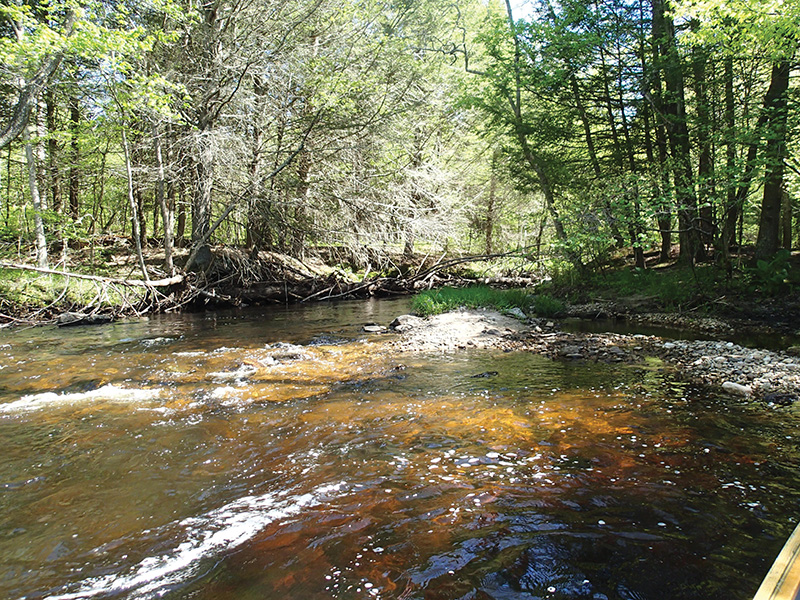
A typical headwater stream characterized by shallow, rocky water, dead wood in the stream, and abundant over-reaching tree canopy resulting in patches of sun and shade on the water. Photo: Sally Harold.
In tributaries, community differences may change quite abruptly. A waterfall (or dam) could prevent fish in the lower river from accessing habitat in the upper river, but changes in stream elevation and water temperatures change habitat, too, and, consequentially, community makeup.
The lower eight miles of the Connecticut River host an estuarine community of fish, including fish that can tolerate some amount of saltwater. Much of the next 300 miles of river hosts a large river fish community dominated by warm-water fish species such as bass, sunfish, catfish, carp, etc. The upper portion of the river hosts a headwater fish community, dominated by cool-water fish, such as trout.
When we talk about headwaters, we don’t necessarily mean just the very northern part of the watershed in Vermont and New Hampshire. We are also referring to the upper portions of tributaries that flow into the main stem in all four states. In Connecticut and Massachusetts, the habitat in the lower portions of larger tributaries such as the Farmington, Salmon, Westfield, and Deerfield rivers can closely resemblethe main stem Connecticut River, which is warm, with more nutrients, higher productivity, and lots of aquatic vegetation and depth variability. These factors contribute to a more varied fish community, and since the main stem is large, it can support large fish, many of which eat smaller fish.
By contrast, the upper tributaries are cool, nutrient-poor, have low productivity, and many fewer fish species. The slow-moving, deep-water habitat of the lower river transitions into steeper, rockier, swift-flowing stream habitat, which is similar to the very northern part of the watershed. This habitat is more conducive to the cool-water species, and because the streams can get quite small and shallow, large fish are uncommon. Large trout may feed on smaller fish, but generally those fish in the headwater communities are feeding on aquatic insects and alga. The fish communities in these reaches may change rapidly, with species diversity and fish size varying predictably by elevation and stream size.
The middle reaches of the Deerfield River, for example, are cool and support large brown, brook, and rainbow trout and a variety of other species including many minnow species like common shiner, fallfish, and creek chub. But when you get into the upper reaches of the tributaries of the Deerfield—like the Chickley or North rivers—many of these species are not found, and the fish community there is very simple.
The smallest streams (many unnamed) are called “first order streams,” and they have no tributaries. When two first order streams come together, they form a second order stream, and so on. These are true headwater streams found at the very uppermost part of a watershed.
Pucker up! White suckers are often found in headwater streams. Photo: Sally Harold.
A first order stream that is a tributary of the Eightmile River in Connecticut is Burnham Brook, which is mostly protected by a land preserve owned by The Nature Conservancy. Electrofishing surveys have revealed the brook contains only three species: brook trout, blacknose dace, and American eel. All are native, and none of them grow very large. This is probably the same fish community that existed when Europeans first arrived on our river in the 1600s. It is unlikely that this small stream was ever stocked with hatchery trout, so even the genome of the brook trout is native. Protecting these first order stream habitats and the native fish communities that inhabit them is critically important. The water quality of these first order streams influences the water quality of the second and third order streams, and the genes of the legacy trout may be important as we try to conserve the species elsewhere.
Burnham Brook occasionally dries up during a long hot, dry summer. Steve remembers walking the totally dry brook with Dr. Dick Goodwin (who donated the land) after an extended drought, and Dick bemoaned the fact that we clearly had lost the brook’s fish community. However, the following year when the brook was flowing again, Steve returned, electrofished, and found the same community: trout, dace, and eel. Fish in first order streams have adapted to the fickle flows in these small streams and have evolved the ability to burrow under the rocks in the streambed where water continues to flow below the surface and keeps the fish alive. Droughts will reduce the populations, but enough fish survive to repopulate the stream when the rains resume.
When you walk along a small headwater stream, you often are swatting mosquitoes and blackflies and may witness hatches of many other non-biting flies such as stoneflies and mayflies. These undeveloped, rocky streams support many aquatic insects that hatch, emerge from water, fly into the air, mate, and die. But while they are still underwater as larvae, they feed these small fish. Everything starts out eating them, but if a trout or an eel gets large enough, it will start eating smaller dace or even other trout. At that point, their growth rate increases and they grow even larger.
What feeds the bugs? These headwater streams don’t support aquatic vegetation like that found in the main stem Connecticut, so a lot of these insects graze on detritus, decomposing leaves, and woody debris. Most headwater streams have a forest canopy that reaches across the entire stream due to their small width. This results in a great many leaves and shed branches falling into the stream. The canopy also contributes terrestrial bugs including small caterpillars and spiders that drop off into the water and are devoured by fish. This canopy also keeps the water temperature cool by providing shade. The canopy changes as one proceeds downstream where much wider rivers have only a small margin of shore-based shade on the water.
There are some fish species that are part of the fish communities in both the headwater streams and the main stem. Two examples are the tessellated darter and the white sucker. These are “generalist” species that can adapt to both environments. White suckers and some minnows may engage in annual springtime upstream migrations that temporarily take them into headwater streams.
There are also migratory species that pass through the main stem on their way to the upland headwater streams. Some diadromous species, such as Atlantic salmon, sea lamprey, and American eel that come from the ocean, historically went all the way into headwater streams. They may be part-time members of a fish community, such as adults during spring spawning or as feeding juveniles. Adult salmon do not penetrate to the first order streams but find gravel beds in the large-to-medium-sized tributaries in which to spawn. However, juvenile salmon might disperse into some of the small tributaries to feed and grow. Adult lamprey may go up into rather small streams, but their eggs and larvae distribute downstream.
A difference between headwater streams and streams lower in the watershed is the lack of nutrients in the headwaters. Some of these nutrients are a natural byproduct of slower, lower rivers that intercept and accumulate nutrients from the upper watershed. Some of the nutrients can be of human origin such as lawn fertilizers or the byproduct of treated sewage.
Another source is “marine derived nutrients” (or MDNs), which are imported from the sea in the form of anadromous fish. Many of these fish die during the spawning migration, and their decomposing bodies feed many resident organisms. Historically, waterfalls and diminished stream size kept these migratory species from contributing MDNs to the headwater streams. When dams were built, they acted in the same way and greatly expanded the portion of the watershed that did not benefit from MDNs. When we remove dams, we often restore the range of the migratory species and restore the flow of MDNs into headwater streams, benefitting the resident trout, dace, and minnow community.
Steve Gephard is a fish biologist who retired from the CTDEEP and has a long association with the Connecticut River. Sally Harold has worked on dam removal and fish passage projects for over 20 years, including as Director of River Restoration and Fish Passage for the Connecticut Chapter of The Nature Conservancy. Steve and Sally collaborate on dam removals and fishway projects through RiverWork, LLC, and can be reached at Riverworkllc@gmail.com.